Use of augmented reality in road safety education to prevent crashes involving cyclists
Uso da realidade aumentada na educação para a segurança viária para prevenir acidentes envolvendo ciclistas
Uso de realidad aumentada y educación en seguridad vial para la prevención de accidentes en ciclistas
DOI: https://doi.org/10.57188/rieca.2026.012
Paula Alejandra Galvis Martínez
Professional in Digital Business. Research seedbed member at Universidad Sergio Arboleda, PRIME Business School. Barranquilla, Colombia. E-mail: paula.galvis02@usa.edu.co.paula.galvis02@usa.edu.co
Adriana Marcela Caceres-Martelo * ORCID: https://orcid.org/0000-0001-5047-4261
Master in Business Administration - MBA. Research professor at PRIME Business School, Universidad Sergio Arboleda, Barranquilla, Colombia. E-mail: adriana.caceres@usa.edu.co.
How to cite:
Galvis, P. y Caceres, A. Use of augmented reality in road safety education to prevent crashes involving cyclists. RIECA, 1(1). e-12. https://doi.org/10.57188/rieca.2026.012
ABSTRACT
In Colombia, the coexistence of motor vehicles and bicycles on public roads represents a growing challenge for road safety, as reflected in high rates of crashes and injuries. Although specific regulations exist, such as Law 1811 of 2016, which establishes a minimum distance of 1.5 meters between motor vehicles and cyclists, enforcement and effective compliance remain limited. Traditional road safety training methods have proven insufficient to generate sustainable behavioral changes among drivers and cyclists. This study proposes an innovative methodology based on the integration of immersive augmented reality (AR) experiences into road safety training processes, with the aim of strengthening risk perception and safe decision-making. The study reviews Colombian legislation and examines successful international experiences in the use of AR for crash prevention. The methodology is structured under Stanford University's CIFE Horseshoe framework, which enables the research problem to be addressed from intuition, literature review, research question formulation, and task and method design. The findings suggest that AR can be an effective tool for reducing crash rates and improving road-user training, while also offering recommendations for the implementation of pilot programs and future research.
Keywords: Augmented Reality; Road Safety Education; Road Safety; Cyclists; Risk Perception.
RESUMO
In Colombia, the coexistence of motor vehicles and bicycles on public roads represents a growing challenge for road safety, as reflected in high rates of crashes and injuries. Although specific regulations exist, such as Law 1811 of 2016, which establishes a minimum distance of 1.5 meters between motor vehicles and cyclists, enforcement and effective compliance remain limited. Traditional road safety training methods have proven insufficient to generate sustainable behavioral changes among drivers and cyclists. This research proposes an innovative methodology based on the integration of immersive augmented reality (AR) experiences into road safety training processes, with the aim of strengthening risk perception and safe decision-making. A review of Colombian legislation is conducted, together with an analysis of successful international experiences in the use of AR for crash prevention. The methodology is structured under Stanford's CIFE Horseshoe framework, allowing the problem to be addressed through intuition, literature review, research question formulation, and the design of tasks and methods. The findings suggest that AR can be an effective tool to reduce crash rates and improve road-user training, providing recommendations for pilot implementation and future lines of research.
Palavras-chave: Augmented Reality; Road Safety Education; Road Safety; Cyclists; Risk Perception.
INTRODUCTION
Urban mobility in Colombia has experienced sustained growth in bicycle use as a means of transportation, driven by public policies focused on sustainability, health, and affordability. Although this progress is positive, it has also created new challenges for road safety, particularly in the interaction between cyclists and motor vehicles. National statistics reveal a concerning incidence of road crashes involving cyclists, many of which could be prevented through stronger road safety education and more effective enforcement of current regulations. Colombia has a robust legal framework: Law 1811 of 2016 promotes bicycle use nationwide and establishes protective measures for cyclists, including the obligation to maintain a minimum lateral distance of 1.5 meters when overtaking, as well as mandatory helmet use and reflective elements [1]. Likewise, the National Traffic Code (Law 769 of 2002, as amended) and Law 2251 of 2022 define clear rules on the behavior of road users and reinforce the protection of vulnerable users [2][3]. Nevertheless, a gap persists between legislation and everyday practice, partly due to the lack of training tools that allow users to experience, in safe environments, the consequences of their decisions.
In this context, disruptive technologies, particularly augmented reality (AR), emerge as high-potential resources for transforming road safety training and awareness processes. Through immersive simulations, AR enables cyclists and drivers to adopt each other's perspective, experience risk situations, and visualize the consequences of their actions, fostering empathy and experiential learning. This immersive capacity is particularly relevant for modifying behavior and reducing crash rates. The potential of AR is evident in initiatives such as the European SAFEDUCA project, which implements AR environments for training vulnerable road users [6]. Several academic studies report significant improvements in risk perception and learning effectiveness through the use of AR [7]. Recent research has even quantified that AR may reduce learning time by approximately 40% and improve performance in practical tests by nearly 75%, highlighting its positive impact on training processes [8]. Consistently, international organizations emphasize the pedagogical potential of AR as an innovative tool in road safety education. For example, the 2025 traffic regulation update by Spain's Directorate-General for Traffic (DGT) reinforces the minimum lateral distance of 1.5 meters and requires drivers to reduce speed by 20 km/h when overtaking cyclists [4], recognizing the importance of protecting these vulnerable users. Similarly, global reports, such as those of the International Transport Forum (ITF), highlight road safety trends and encourage the integration of emerging technologies such as AR into educational programs [9], providing an international framework for contextualizing the findings of this research.
Despite institutional efforts, traditional road safety education methods, mainly based on lectures, static signage, and information campaigns, have been insufficient to produce meaningful behavioral changes among road users. Road crashes in Colombia remain a critical public health issue: in 2022, the country recorded 8,032 deaths from road crashes, representing a 13.1% increase compared with the previous year [10]. Motorcyclists were the most affected group, accounting for 60% of deaths, followed by pedestrians (21.3%) and private vehicle drivers (7.6%). Cyclists also face high levels of vulnerability, with 437 deaths in 2022, approximately 5.4% of total fatalities [10]. Preliminary figures for 2023 indicate that crash mortality remained high, with 8,405 deaths nationwide [11]. These data show that current strategies have not effectively contained the phenomenon. Therefore, it is necessary to explore new training methodologies, such as AR, that foster experiential learning and empathy between drivers and cyclists, contributing to crash reduction and the strengthening of road safety culture. In this context, the following research question is posed: How can augmented reality contribute to the awareness and training of cyclists to prevent road crashes in Colombia?
It is hypothesized that AR can serve as an innovative road safety training tool by allowing users to experience, in an immersive and safe manner, the consequences of their decisions on the road. To answer the research question, the general objective of this study is to propose a road safety training methodology based on immersive AR experiences aimed at preventing bicycle crashes in Colombia, integrating an analysis of national legislation and a comparison with an international reference case, Spain. Specifically, the study pursues the following objectives: (i) to review current Colombian legislation on cyclist road safety, identifying gaps and opportunities for improvement; (ii) to review successful international experiences in the use of AR for road crash prevention; and (iii) to design road safety training scenarios using AR, focused on the simulation of risk situations and safe decision-making. The scope of the study is limited to the conceptual design phase of the methodological proposal and does not include large-scale implementation or longitudinal field evaluation.
THEORETICAL FRAMEWORK
Experiential education. Experiential education, proposed by Kolb in 1984, holds that meaningful learning emerges from direct experience and reflection on that experience. The model is structured in four stages - concrete experience, reflective observation, abstract conceptualization, and active experimentation - which feed back into a continuous learning cycle. In the context of road safety education, this approach allows users to experience risk situations, reflect on their decisions, and modify their behavior based on the lived experience, fostering deeper and more lasting behavioral change [16].
Augmented reality in learning. Augmented reality (AR), defined by Azuma (1997) as the real-time overlay of virtual elements onto the physical environment, has become a high-impact educational tool [12]. Billinghurst and Duenser highlight its capacity to enrich learning through immersive experiences that combine real and virtual elements [13]. In the field of road safety education, AR makes it possible to simulate traffic scenarios, foster empathy among road users, and improve participants' risk perception. Moreover, AR shares with gamification the potential to increase motivation and improve knowledge retention by offering more interactive and playful learning experiences. Along these lines, Villafan and Linares (2024) note that gamified activities have a high capacity for memory retention and allow knowledge to be constructed in a more enjoyable and effective way [15]. This observation supports the premise of the present study regarding the pedagogical potential of AR in road safety education, since its playful and immersive nature may lead to more meaningful and lasting learning in cyclist safety.
Several academic studies have reported significant improvements in learning effectiveness and risk perception through the use of AR in road safety training [7][8]. For example, the European SAFEDUCA experience has demonstrated effectiveness in training vulnerable users such as cyclists and pedestrians through augmented virtual environments [6]. Recent studies also indicate that AR may considerably reduce the learning time required, by about 40%, and improve performance in practical assessments by approximately 75% compared with traditional methods [8]. These findings underscore the positive impact that augmented environments may have on training processes. Consistently, literature reviews highlight the strong potential of AR as an innovative pedagogical tool in road safety education, as it combines visual, interactive, and contextual components that facilitate deeper learning and greater awareness of traffic risks.
Road safety culture and risk perception. Road safety culture and risk perception are key factors in crash prevention. The World Health Organization (WHO) notes that more than 1.2 million people die each year in road traffic crashes worldwide, and that pedestrians, cyclists, and motorcyclists represent nearly 49% of those deaths in the Region of the Americas [12]. In Colombia, the National Road Safety Agency (ANSV) has identified an increase in cyclist crash rates, even during periods of reduced mobility during the pandemic, which demonstrates the persistence of risk for this group despite lower traffic volumes [10]. The International Transport Forum (ITF) also promotes data collection and trend analysis in global road safety, emphasizing the importance of integrating emerging technologies such as AR into educational programs to improve the safety of vulnerable road users [9]. These international initiatives reinforce the need to adopt innovative approaches that strengthen road safety culture and improve risk perception among road users.
Limits and challenges of augmented reality. Despite its pedagogical benefits, the implementation of AR in training environments faces important challenges. First, technological accessibility remains limited in many contexts, especially in rural areas or places with low connectivity, making mass adoption difficult [6]. In addition, the costs associated with developing AR content, acquiring devices such as specialized headsets or viewers, and training instructors can be high [8]. A digital divide also persists that could exclude vulnerable population groups, limiting equitable access to AR-based training programs [9]. These factors must be carefully considered when designing implementation strategies so that the proposed technological solutions are not only effective, but also inclusive and sustainable over the long term. Any AR initiative in road safety education should be planned to minimize these gaps, seeking institutional partnerships and financing models that can bring technological innovation to the contexts where it is most needed.
- Research Methodology
This research was structured using Stanford University's CIFE Horseshoe methodology, which facilitates a comprehensive approach to complex problems by connecting initial intuition with literature review, question formulation, method design, and results review. This framework ensures coherence and rigor throughout the research process, establishing a logical bridge between the observed problem and the contribution to knowledge.
Phase 1
Literature review. In the initial phase, an exhaustive review of relevant bibliographic and documentary sources was conducted. First, cyclist road safety regulations in Colombia were analyzed, including the laws mentioned in the Introduction (Law 1811 of 2016, Law 2251 of 2022, and the updated Traffic Code), identifying the key provisions for cyclist protection, such as the minimum overtaking distance and the mandatory use of safety elements, as well as possible gaps in their application [1][2][3]. In addition, the international reference legislation for this study was reviewed: Spanish regulations, which recently incorporated significant changes in favor of cyclist safety [4]. Specifically, the 2025 DGT update, which requires a 1.5-meter lateral distance and a speed reduction of 20 km/h when overtaking a cyclist, was considered as a comparison point for the Colombian context.
The literature review also covered the use of immersive technologies in road safety education at the international level. For example, the European SAFEDUCA project was identified, which uses AR environments to train vulnerable road users [6]. Similarly, academic studies showing the advantages of AR in educational environments were reviewed, particularly in relation to experiential learning and improved perception of road risks [7][8]. Some studies reported illustrative quantitative data, such as significant reductions in the time needed to acquire certain road-circulation skills when AR simulators were used [8]. Finally, reports and publications by international organizations, such as the ITF, were considered, as they provide a global framework on road safety trends and underline the relevance of integrating innovative technological tools into road safety training [9].
Phase 2
Design and development of AR scenarios. Using the theoretical and contextual inputs gathered, the second phase focused on designing the AR-based training proposal. The process began with the identification of typical risk situations in car-bicycle interaction, selecting the most frequent and critical scenarios reported in the literature and in Colombian crash statistics. These included vehicles overtaking cyclists without maintaining a safe distance, imprudent turns and maneuvers that endanger cyclists, invasion of bicycle-only infrastructure, and unexpected obstacles on the road, among others. Each selected situation was contextualized within the current Colombian legal framework, for example by highlighting the legal obligation to yield or maintain the required distance, depending on the case, and was then incorporated into the simulations.
Next, immersive AR experiences were designed to allow users to assume the role of cyclists and interactively face the identified risk situations. Scripts and storyboards were prepared for each scenario, defining the initial conditions, the events - such as the sudden appearance of an obstacle or a close vehicle overtake - the user's possible decisions, and the simulated consequences of those decisions. The technical development of the prototype was carried out using 3D modeling and animation tools; for example, Fusor software and urban modeling resources were used to recreate realistic traffic environments. In this way, a conceptual prototype of an AR simulator for cyclists was developed. The prototype includes multiple interactive scenarios that reflect real driving situations.
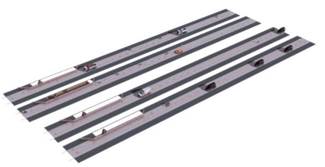
Figure 2 provides an overview of the different scenarios included in the developed prototype.
Figure 2.
Visualization of the different prototype scenarios
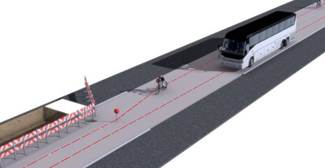
In one simulation scenario, the cyclist must ride correctly in the right lane, avoiding high-speed lanes, as represented in Figure 3.
Figure 3.
The cyclist must use the right-hand lane
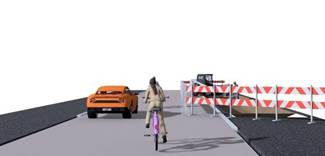
Another scenario presents the sudden appearance of an unexpected obstacle in the cyclist's path, requiring the user to react and avoid it safely, as shown in Figure 4.
Figure 4.
The cyclist encounters an obstacle in the path
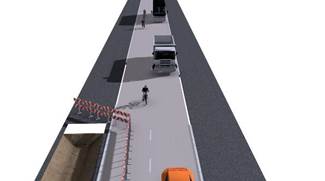
This is complemented by an aerial perspective of the same scenario in Figure 5.
Figure 5.
Aerial view of the obstacle scenario
A first-person visualization from the cyclist's role was also implemented, increasing immersion and empathy by allowing users to experience traffic from that perspective, as shown in Figure 6.
Figure 6.
First-person cyclist role
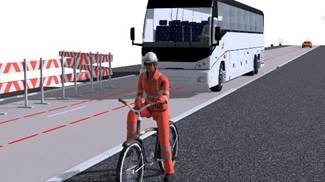
Each scenario explicitly integrated regulatory elements. For example, if the user virtually failed to respect the safe distance during an overtaking maneuver, the simulation displayed the consequences, such as a crash or a significant near miss, and recalled the applicable regulation. This created a direct connection between the rule, compliance with it, and the experienced outcome.
During prototype development, usability and user experience were also considered. Simple and intuitive interactions were incorporated so that the target audience, young and adult cyclists, could focus on road safety decisions rather than on managing the technological interface.
Phase 3
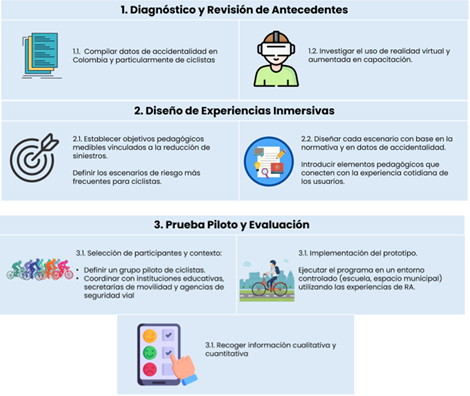
Formulation of the methodological proposal. In the final stage, the findings and outputs of the previous phases were synthesized to articulate the AR-based road safety training methodology in an integrated manner. This involved documenting and organizing the sequence of steps required to implement the training program, from the identification of training needs to the evaluation of the AR experience. Figure 7 summarizes the proposed methodology as a whole.
Figure 7.
Detailed methodological proposal
Likewise, Figure 8 illustrates the prototype developed for the case study, including visual examples of the simulated traffic situations.
Figure 8.
Case study
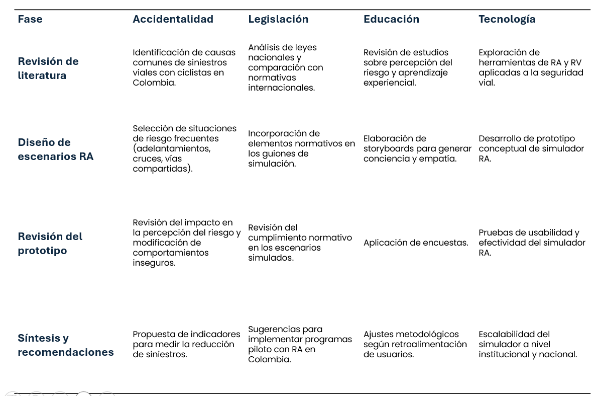
This representation clearly communicates the structure of the program and its technological component to authorities, road safety educators, and potential implementation partners.
At the end of this phase, a complete methodological proposal and a concept-level functional prototype were available. Although the practical implementation of the methodology remains future work, concrete recommendations for its implementation were defined, including the need for partnerships with traffic authorities to deploy pilot programs, training instructors in the use of AR, and complementary materials to reinforce immersive sessions. In summary, the resulting methodology integrates experiential pedagogical approaches, local regulatory content, and technological innovation, and is flexible enough to be adapted to diverse urban contexts in Colombia.
EXPECTED RESULTS AND DISCUSSION
The results of this research are reflected in a set of theoretical and practical contributions to the field of road safety and technology-supported education:
Innovative road safety training methodology: An original methodology is proposed for road safety education based on immersive AR experiences. Unlike traditional approaches, this methodology immerses users in simulated traffic situations, allowing them to experience first-hand the consequences of their decisions. This experiential approach promotes comprehension and retention of road safety concepts while fostering empathy between drivers and cyclists. The methodology is specifically oriented toward the prevention of crashes involving cyclists in the Colombian context, although its principles may be applicable to other contexts and road users. Figure 9 presents the detailed structure of the proposed methodology and how each component contributes to the defined learning objectives.
Simulation scenarios for road safety training: As part of the methodology, AR scenarios were developed to reproduce critical situations of road interaction. These scenarios constitute a pedagogical tool in themselves, as they allow users to experience, in safe environments, situations that would be dangerous or high-risk in real life. By assuming the role of cyclist in the simulator, participants can more vividly perceive the importance of actions such as respecting safety distances or anticipating obstacles. This favors the internalization of safe behaviors, because learning emerges not only from theoretical instructions but from simulated experiences. In addition, the scenarios integrate the relevant traffic regulations so that users receive immediate normative feedback, for example a reminder of Law 1811 of 2016 if a virtual vehicle comes too close in the simulation. In this way, the gap between regulation and practice is reduced: participants understand the rationale and implications of the rule not only in the abstract, but in a concrete situation.
Evidence on the acceptance of AR in road safety education: The study provided preliminary evidence on the acceptance and potential impact of AR in road safety training. Although behavioral changes were not formally measured, as the project did not include a longitudinal follow-up phase, qualitative observations suggest that AR may increase awareness of risks and motivate users to comply with regulations based on their own conviction after experiencing the consequences of non-compliance. This result supports findings from other studies that link immersive experiences to greater training effectiveness [7][8]. Areas for improvement were also identified, such as simplifying certain interface controls, which will serve as a basis for optimizing future versions of the simulator.
Foundations for future research and development: This research opens new lines of work for both evaluation and expansion of the methodology. On the one hand, it establishes foundations for larger-scale pilot programs whose results can be assessed in terms of actual reductions in incidents or improvements in participants' knowledge and practices. On the other hand, the methodology could be adapted to other vulnerable groups, such as pedestrians or motorcyclists, or to other urban environments, requiring adjustments to the scenarios while maintaining the experiential AR pedagogical core. There is also an opportunity to incorporate more sophisticated simulator metrics, such as gaze tracking or stress biofeedback, to analyze in greater detail how users interact with the tool and how effective it is in modifying perceptions and actions. Overall, this work presents a reference framework that future researchers and practitioners can use and improve by combining road safety education and immersive technologies to address the global challenge of cyclist safety.
From a practical perspective, the findings of this research have important implications for various stakeholders seeking to strengthen road safety and reduce crashes involving cyclists and drivers: (1) The study offers an innovative and adaptable tool for public entities, traffic agencies, educational institutions, and private companies interested in road safety training programs. The AR methodology can be incorporated into road safety curricula, driver training courses, or awareness campaigns, standing out for its interactive and engaging nature. (2) The results facilitate the updating and improvement of existing training programs by showing that immersive technologies can increase active participation, motivation, and meaningful learning compared with traditional methods.
This could lead driving schools and community road safety initiatives to rethink their pedagogical strategies by integrating AR components to make them more effective. (3) The proposal contributes to closing the gap between regulation and everyday road behavior. By allowing users to realistically understand and experience the consequences of their actions, such as perceiving crash risk when safe distance is not maintained, it promotes greater adherence to current legislation through personal conviction rather than merely avoiding fines. (4) Finally, this work lays the groundwork for collaborative pilot programs. For instance, a city could implement an AR training pilot for urban cyclists involving traffic authorities, universities for technological support, and cyclist associations. The evaluation of such a pilot would provide valuable data on the effectiveness of the methodology under real conditions, generating knowledge applicable to public policy and program scaling.
CONCLUSIONS
This study addressed the problem of high crash rates involving cyclists in Colombia through the design of an immersive road safety education methodology based on augmented reality. As a result, an innovative training proposal was developed that integrates legal knowledge, interactive virtual scenarios, and experiential learning principles to improve risk awareness and encourage safer road behaviors. The proposed methodology, structured under the CIFE Horseshoe model, proved conceptually viable and technically feasible through the implemented prototype. Although longitudinal measurements were not conducted within the scope of this work, the evidence gathered suggests that AR has the potential to positively transform road safety education practices by achieving greater participant engagement and a deeper understanding of the consequences of road behavior.
In summary, augmented reality emerges as an effective tool for preventing traffic crashes involving cyclists, complementing and strengthening traditional training approaches. By placing users at the center of an immersive and controlled experience, it achieves a balance between theory and practice that may translate into sustainable behavioral change over time. This approach responds to the urgent need to experiment with new educational methodologies in the face of persistent road safety challenges in urban environments.
As future work, it is essential to move this proposal from the conceptual environment to real-world implementation. Pilot projects in Colombian urban settings are recommended, accompanied by rigorous impact evaluation to quantify reductions in incidents and improvements in participants' attitudes and behaviors. It will also be valuable to explore the adaptability of the methodology to other areas, such as pedestrian safety or professional driver training, and its scalability with the support of public policies. Further research should also deepen solutions to overcome the identified barriers, ensuring that AR technology can be accessible to a broad and diverse public.
In conclusion, the integration of augmented reality into road safety education represents a promising avenue for strengthening road safety culture and protecting the lives of the most vulnerable road users. The findings of this study constitute a solid starting point for future innovations that, with the collaboration of government entities, the education sector, and civil society, can significantly contribute to the prevention of road crashes and the construction of safer and more sustainable mobility environments.
REFERENCES
Agencia Nacional de Seguridad Vial [ANSV]. (2023, 31 de enero). Observatorio Nacional de Seguridad Vial realizó balance de la siniestralidad durante el 2022 [Comunicado de prensa]. Ministerio de Transporte de Colombia. Disponible en: https://www.mintransporte.gov.co.
Antúnez, A. M. C., Morales, C. E. B., & Araujo, D. R. S. (2019). La sostenibilidad global en una empresa de transporte urbano de viajeros en autobús: Estudio de caso. En Memorias del III Congreso Internacional en Administración de Negocios Internacionales (CIANI): Retos y oportunidades del desarrollo sostenible en los negocios internacionales (pp. 28–42). Universidad Pontificia Bolivariana.
Arrieta, L. E., & Morales, C. E. B. (2024). Necesidades sociales y dimensiones del capital social: análisis de beneficiarios de Familias en Acción. Telos: Revista de Estudios Interdisciplinarios en Ciencias Sociales, 26(2), 388–407.
Azuma, R. T. (1997). A survey of augmented reality. Presence: Teleoperators and Virtual Environments, 6(4), 355–385.
Barrera, M. B., & Morales, C. E. B. (2025). Análisis de la percepción de la cultura tributaria en Colombia durante el periodo pospandemia. Dictamen Libre, (36), 2.
Billinghurst, M., & Duenser, A. (2012). Augmented reality in the classroom. IEEE Computer, 45(7), 56–63.
Borja-Barrera, M., & Barragán-Morales, C. (2025). Perception analysis of tax culture in Colombia during the post-pandemic period. Dictamen Libre, (36).
Congreso de la República de Colombia. (2016). Ley 1811 de 2016: Por la cual se promueve el uso de la bicicleta en el territorio nacional y se dictan otras disposiciones. Disponible en línea: https://www.suin-juriscol.gov.co/viewDocument.asp?ruta=Leyes/30027024.
Congreso de la República de Colombia. (2022). Ley 2251 de 2022: Seguridad Vial y Movilidad Activa. Disponible en línea: https://leyescolombianas.com.co/normas-ciclistas-colombia-2025/.
Congreso de la República de Colombia. (2025). Código Nacional de Tránsito. Ley 769 de 2002, actualizado. Disponible en línea: https://leyes.co/codigo_nacional_de_transito_terrestre/94.htm.
Dirección General de Tráfico [DGT]. (2025). Nueva normativa para ciclistas: Cambios importantes en la Ley de Tráfico. El Periódico. Disponible en: https://www.elperiodico.com/es/trafico-y-transportes/20241206/dgt-cambia-normativa-ciclistas-2025-dv-112106492.
Drive Autoescuelas. (2025). Cambios clave en la normativa DGT para ciclistas. Disponible en: https://driveautoescuelas.com/nueva-normativa-de-la-dgt-para-ciclistas-cambios-importantes-para-2025/.
EL.INSIA-UPM. (2024). Proyecto SAFEDUCA: Realidad aumentada y virtual para educación vial [Proyecto de investigación]. Disponible en: https://insia-upm.es/project/proyecto-safeduca/.
Espitia-Arrieta, L., Prestan-Gómez, S. T., & Barragán-Morales, C. (2022). Programas de transferencias monetarias condicionadas: una comparación en América Latina frente a Familias en Acción. Dictamen Libre, (31).
International Transport Forum [ITF]. (2025). Tendencias globales en la reducción de accidentes viales. Disponible en: https://www.valoraanalitik.com/estas-son-las-tendencias-globales-en-la-reduccion-de-accidentes-viales/.
González, Jesús, Mendoza, Leonilde, Olmos, Greys y Miranda Passo, Juan. “La Universidad como agente de desarrollo socioeconómico en Latinoamérica”, Dictamen Libre, núm. 34 (marzo 2024). 179-190, https://doi.org/10.18041/2619-4244/dl.34.11727
Kolb, D. A. (1984). Experiential learning: Experience as the source of learning and development. Prentice Hall.
Ministerio de Transporte & Agencia Nacional de Seguridad Vial [ANSV]. (2024, 7 de febrero). En 2023 se contuvo el fenómeno de la siniestralidad vial en Colombia [Comunicado de prensa]. Disponible en: https://www.mintransporte.gov.co.
Morales, C. E. B., De Moya, F. E. M., Vélez, N. S., & Vargas, E. C. (2023). Innovación social: Una aproximación desde su relación con la responsabilidad social empresarial en tiempos del COVID-19. En Investigación y Desarrollo (pp. 137–150). Fondo Editorial CIIDIES.
Morales, C. E. B., Guarín-García, A. F., Chang-Muñoz, E. A., Villanueva-Vásquez, A., Gálvez, J. F. E., Delgado, N. A. G., & Bracho, O. C. (2025). Fuzzy-set qualitative comparative analysis to corporate social responsibility components: A case study from media print companies in Atlántico Department of Colombia. Procedia Computer Science, 257, 1148–1153.
Morales, C. E. B., Mendoza, A. P., Barrera, M. B., & Osorio, F. M. (2024). Transformational leadership and decision-making in organizations of the Colombian Caribbean. Dictamen Libre, (34), 167–178.
Mudarra-Fernández, A. B., Barragán-Morales, C. E., & González-Beleño, C. (2023). La eficiencia de las empresas con marca en los hoteles de las Ciudades Patrimonio de la Humanidad consolidadas de España. Revista Ibérica de Sistemas e Tecnologias de Informação, (E60), 624–636.
Organización Mundial de la Salud [OMS]. (2023). Global status report on road safety 2023. OMS. Disponible en línea: https://www.who.int/publications/i/item/9789240060881.
Turizo, J. M., Bracho, O. C. C., & Morales, C. B. (2026). General and differential mechanisms of citizen participation: Prior consultation and victims’ participation boards. Pensamiento Americano, 19(39).
Tuteórica. (2024). Educación vial y realidad aumentada: aplicaciones prácticas [Blog en línea]. Disponible en: https://tuteorica.com/blog/ia/educacion-vial-y-realidad-aumentada/.
Universitat Oberta de Catalunya [UOC]. (2025). Realidad aumentada como herramienta para aumentar el aprendizaje del alumnado [Noticia]. Disponible en: https://www.uoc.edu/es/news/2025/realidad-aumentada-una-herramienta-para-aumentar-el-aprendizaje-del-alumnado.
Villafán Amezcua, L. A., & Linares, É. (2024). Aprendizaje basado en gamificación. Revista Iberoamericana de Tecnología en Educación y Educación en Tecnología (TEyET), 38, 9–19.