Emotional Intelligence in Decision-Making to Help SME Employees Achieve Their Goals, Lima, 2025
A Inteligência Emocional na Tomada de Decisões para Ajudar os Colaboradores das PME a Alcançar os Seus Objetivos, Lima, 2025.
La inteligencia emocional en la toma de decisiones para ayudar a los empleados de las pymes a alcanzar sus objetivos, Lima, 2025.
DOI: https://doi.org/10.57188/rieca.2026.007
José Tarrillo Paredes * ORCID: https://orcid.org.0000-000-3229-3189
José Eber Paz Vilchez * ORCID: https://orcid.org. 0000-0002-1711-3795
Sandrita Aracely Huamán Moreto * ORCID: https://orcid.org.0000-0001-5091-9363
How to cite:
Tarrillo, J., Paz, J. y Huamán, S. (2026). Emotional Intelligence in Decision-Making to Help SME Employees Achieve Their Goals, Lima, 2025. RIECA, 1(1). e-007. https://doi.org/10.57188/rieca.2026.007
ABSTRACT
This study argues that decision-making is a process in which emotional intelligence and cognitive intelligence are integrated into actions aimed at achieving the goals proposed by employees. The objective of this research was to determine the relationship between emotional intelligence and decision-making in achieving the goals of employees of SMEs in Lima, 2025. The study used a non-experimental, quantitative, correlational, and propositional methodology. The population consisted of 12,200 employees and the sample included 1,209 participants. A Pearson correlation coefficient of 0.830 was obtained, indicating that emotional intelligence is an important indicator for decision-making within small companies in Lima, especially considering that many companies may fail if they do not care for their personnel and the emotional intelligence they develop. The study concluded that there is a relationship between managerial decision-making and success in goal achievement. The model applied in this research also showed that this relationship is highly influential, meaning that decisions made by SMEs regarding their structure and projects have repercussions on goal achievement. Therefore, SMEs must maintain order, organization, and planning because, due to their size, any decision may have a decisive effect on their results. Decision-making is a process through which individuals attempt to change the course of events in their effort to achieve goals that provide well-being, prosperity, and ultimately happiness.
Keywords: Emotional Intelligence; Decision-Making; Goal Achievement.
JEL Code: M1, M12, L1, M13
RESUMO
Este estudo defende que a tomada de decisão é um processo no qual a inteligência emocional e a inteligência cognitiva se integram em ações voltadas para o alcance das metas propostas pelos funcionários. O objetivo desta pesquisa foi determinar a relação entre a inteligência emocional e a tomada de decisão no alcance das metas dos funcionários de PMEs em Lima, em 2025. O estudo utilizou uma metodologia não experimental, quantitativa, correlacional e proposicional. A população consistiu em 12.200 funcionários e a amostra incluiu 1.209 participantes. Foi obtido um coeficiente de correlação de Pearson de 0,830, indicando que a inteligência emocional é um indicador importante para a tomada de decisões em pequenas empresas em Lima, especialmente considerando que muitas empresas podem fracassar se não cuidarem de seu pessoal e da inteligência emocional que desenvolvem. O estudo concluiu que existe uma relação entre a tomada de decisões gerenciais e o sucesso na realização de metas. O modelo aplicado nesta pesquisa também mostrou que essa relação é altamente influente, o que significa que as decisões tomadas pelas PMEs em relação à sua estrutura e projetos têm repercussões na consecução de metas. Portanto, as PMEs devem manter a ordem, a organização e o planejamento, pois, devido ao seu tamanho, qualquer decisão pode ter um efeito decisivo sobre seus resultados. A tomada de decisão é um processo através do qual os indivíduos tentam mudar o curso dos eventos em seu esforço para alcançar metas que proporcionem bem-estar, prosperidade e, em última instância, felicidade.
Palavras-chave: Inteligência emocional; tomada de decisão; alcance de metas.
INTRODUCTION
The research problem addressed in this study emerged from conversations with managers of SMEs in the province of Lima, who reported difficulties related to employees’ decision-making. This study argues that decision-making is a process in which emotional intelligence and cognitive intelligence are integrated into actions aimed at achieving the goals proposed by employees. Within this context, the study seeks to identify the relationship among the three variables under analysis, considering that the population is composed of the main SMEs in the province of Lima. These variables are emotional intelligence, decision-making, and goal achievement, which together form the basis of the theoretical model.
Society is immersed in a new digital era. Therefore, teaching, learning, and the use of technology are no longer sufficient; it is also necessary to develop competencies, since new generations already operate autonomously in technological and digital environments. However, because this environment is unstable, it is increasingly necessary to educate for competence rather than for mere technical handling, placing emphasis on soft skills (Rivera-Vargas & Lindín, 2018). Digitalization and information and communication technologies (ICTs) have not only modified learning but have also drastically transformed the current labor market. Competition now takes place in a global labor market, where technical knowledge alone is insufficient (Hernández-Lahoz, 2016, p. 49). Fernandez-Ronquillo, Llinas-Audet, and Sabate (2018) indicate that recent research has emphasized the importance of developing social skills, also known as emotional intelligence, because these skills provide individuals with a differential value and allow them to be highly competitive in the workplace. Emotional intelligence also contributes to a better organizational climate. Goleman (1999) affirmed that emotional intelligence is composed of a set of innate or acquired human skills, among which perseverance, empathy, self-motivation, enthusiasm, and self-control stand out, all of which are highly beneficial for personal development. In contemporary organizations, which operate under constant pressure and changing commercial environments, companies seek employees capable of facing such pressures. This allows business activities to be managed more effectively. It is also beneficial for workers to maintain control over their emotional states, since emotions influence their ability to perform tasks and pursue objectives. Consequently, their decisions are more sustainable and contribute to the achievement of both organizational and individual goals (Cuevas et al., 2013).
Many studies on emotional intelligence state that it is a very important managerial skill in any company, since it makes employee performance more efficient and therefore highly valuable (Pereda, López-Guzmán, & González, 2018). Idalberto Chiavenato (2011) argues that managers, administrators, and personnel with decision-making responsibilities bear the great responsibility of achieving the goals established for organizational growth and ensuring that these decisions produce positive results both economically and in terms of human resources. Yabar (2016), in turn, states that recognizing and developing emotions enhances intellectual performance, values, initiative, collaboration, creativity, and the proper management of one’s own emotions and those of others, thereby contributing to leadership development. Furthermore, emotional intelligence, through proper decision-making, implies the achievement of important goals not only for the company but also for the worker (Huaman, 2012).
A clear example of companies taking emotional management seriously is McDonald’s, a globally recognized company that values young people with emotional intelligence when hiring them and allowing them to build a career path. For this company, demonstrating leadership, teamwork, adaptability to change, and interpersonal communication skills can be as important as, or even more important than, previous work experience, since in many cases professional experience is not required (Garza, Garabito, Hernández, Rodríguez, & Olivo, 2009). Its policies are based on the idea that a person with emotional intelligence is capable of solving problems and innovating, achieving greater acceptance of their decisions and contributing to goal achievement and work performance (Horna Figueroa, 2005).
In Ecuador, microentrepreneurs recognize the benefits of emotional intelligence. Specialists estimate that emotional intelligence provides a competitive advantage because it strengthens motivation, interpersonal relationships, self-knowledge, self-control, and empathy both in entrepreneurs and in their personnel, improving commercial management by 62% and enabling the creation of long-term service and business relationships (Velasquez, Suarez, Serrano, & Yance, 2016).
In Peru, in recent years emotional intelligence has become a fundamental factor motivating employees at all hierarchical levels to remain in or leave the company where they work. People not only seek employment to produce and generate results, but also a space for relationships and professional growth. As one of the consequences of poor managerial practices, Peru’s average labor turnover rate reaches 20.7%, while voluntary turnover reaches 9.8% (El Economistamerica.pe, 2019). Additionally, 25% of turnover is related to work stress and high labor pressure, situations in which employees may be unable to manage their workload or perform adequately (Cayetano Saldaña, 2015).
The department of Lima, and especially its SMEs, is not exempt from the problems associated with emotional intelligence and its relationship with decision-making and goal achievement. Employees, including managers, administrators, and area heads at the executive level, do not always adapt easily to the trend of delegating responsibility and decision-making, nor to providing effective organizational communication that allows goals to be achieved. Insufficient knowledge of the job position may also prevent employees from making optimal decisions. This study is framed within the line of organizational behavior research related to the management of material and human resources. Therefore, this research measures the level of significance in the relationship among the variables in relation to the results of SMEs in Lima.
METHODOLOGY
This section presents the research methodology, which determines how the study is developed and describes the approach, design, and type of research on which the study is based.
Type of research
This research is based on the hypothetical-deductive method. According to Molero (2016), this method is applied to studies that maintain a hypothesis and has ontological and epistemic foundations, as it is based on the lived experiences of the subjects under study and is situated within the ontological approach of positivism. The research design is non-experimental because the variables are not deliberately manipulated, and it is cross-sectional because data are collected at a single point in time (Hernández Sampieri, 2014). The study follows a quantitative approach, which has a sequential logic and seeks to test propositions. Each stage precedes the next, and steps cannot be skipped, although some phases may be reorganized. The process begins with an idea that is progressively delimited; once established, objectives and research questions are derived, and books and previous studies are reviewed to develop a theoretical framework. In the quantitative approach, data are collected to test hypotheses based on numerical measurement and statistical analysis, allowing theories to be tested and behavioral patterns to be established. This study is basic and correlational, since it analyzes the relationship among emotional intelligence, decision-making, and employees’ goal achievement in companies.
Research design
The design of this study is non-experimental because the data are processed according to the responses provided by the participants. Fuentes (2014) states that non-experimental research generally offers greater transparency in the data to be processed because the data are not manipulated at the researcher’s convenience and do not need to be altered. The study is cross-sectional because it is conducted within a single period; this concept is supported by Yserm (2016), who states that studies that delimit or determine an exact period for applying the instrument use a cross-sectional design. In this case, the variables emotional intelligence and decision-making are analyzed in relation to success in goal achievement.
Population and sample
Population
The reference population is composed of SMEs registered in commercial activities in the city of Lima. Cruz and Vargas (2017) state that a population is the general set to which the researcher intends to apply the study. In this research, the total population is 12,200 employees, distributed across different sectors as detailed below.
Table 1
Population distribution
|
Areas |
Number of employees |
|
Construction |
2000 |
|
Manufacturing |
500 |
|
Domestic consumption |
1500 |
|
Agriculture and livestock |
200 |
|
Fishing |
1000 |
|
Transportation and communications |
3000 |
|
Automotive |
1000 |
|
Food and beverages |
2000 |
|
Tourism, gastronomy, and hospitality |
1000 |
|
Total population |
12 200 |
Sample
For this study, a sample of 1,209 workers was determined through non-probability convenience sampling. Castro et al. (2019) define the sample as the specific subset to which the study is applied and from which the research results are obtained. The sample is also the core group that provides the information. The study attempted to reach as many participants as possible, obtaining a significant sample size that exceeded the size recommended for a 95% confidence level and a 5% margin of error.
Table 2
Sample determination
|
AREAS |
N° |
n |
|
Construction |
2000 |
180 |
|
Manufacturing |
500 |
50 |
|
Domestic consumption |
1500 |
120 |
|
Agriculture and livestock |
200 |
30 |
|
Fishing |
1000 |
134 |
|
Transportation and communications |
3000 |
341 |
|
Automotive |
1000 |
134 |
|
Food and beverages |
2000 |
180 |
|
Tourism, gastronomy, and hospitality |
1000 |
40 |
|
Total population |
12 200 |
1209 |
Sampling method and type
This research is quantitative because it addresses quantifiable results and uses information obtained from data collection; it can work with populations of different sizes. Arzate (2019) also notes that these studies involve a statistical process.
The sampling method was non-probabilistic by quotas, since the study sought the available sample to which the researcher had access. Castro et al. (2019) state that non-probability convenience studies are those in which the researcher has full access to the population and includes those who participate in the study, characterized by the possibility that all accessible individuals may be included.
Sampling procedure
The sampling procedure was selected based on the number of workers in the different sectors. The study developed a stratification of the sectors, seeking a sample size appropriate to the research and consistent with the proposed methodology. The variables and their purpose were then analyzed, resulting in a sample composed of individuals from different work sectors.
Inclusion and exclusion criteria
· Inclusion criteria
Employees with an active contract and employees working specifically in administrative, commercial, and production areas.
· Exclusion criteria
Employees who refused to complete the survey and employees who were on vacation or whose employment was suspended at the time the survey was administered.
Research hypotheses
· General hypothesis:
H1. The structural model of emotional intelligence and managerial decision-making has a significant effect on success in goal achievement among employees of SMEs in Lima, 2025.
· Specific hypotheses:
H1. There is a relationship between emotional intelligence and decision-making among employees of SMEs in Lima, 2025.
H1. There is a relationship between emotional intelligence and goal achievement among employees of SMEs in Lima, 2025.
H1. There is a relationship between decision-making and goal achievement among employees of SMEs in Lima, 2025.
Ibáñez (2015) states that study variables are the central component of any research process because they constitute the object of study. These variables frame the influence of one variable over another or the relationships among them. As the theoretical development of each variable progresses, the theoretical model is created, as shown below:
Figure 1
Research design on emotional intelligence, goal achievement, and
decision-making.
Source: Research design on emotional intelligence by Ibáñez (2015).
RESULTS
Outliers
Mahalanobis distance, according to Tabachnick and Fidell (2013), is evaluated as a chi-square statistic (X2) “with degrees of freedom equal to the number of variables” (p. 99). In this study, Mahalanobis values were compared with the critical chi-square values for the three study variables, and values greater than the critical value of X2 (df = 3, p = .001) = 18.47 were considered outliers. As a result, six cases were identified and removed: ID 101, 439, 777, 112, 450, and 788.
Cook’s distance was also used to measure the total influence of a case on the model’s ability to predict all cases. Cook and Weisberg (1982) suggested that values greater than 1 may be considered influential, resulting in an adjusted dataset of 1,209 cases. It can therefore be concluded that the Mahalanobis distance analysis applied to all variables did not present data points excessively distant from the rest, and Cook’s distance was less than 1 for all variables, meaning that there was no important influence of outliers.
Table 3
Mahalanobis distance and Cook’s distance for detecting outliers
|
N° |
ID |
Mahalanobis distance |
Cook’s distance |
p value |
|
1 |
101 |
2,026,581 |
0.00837 |
0.0001 |
|
2 |
439 |
2,026,581 |
0.0007 |
0.0001 |
|
3 |
777 |
2,026,581 |
0.00148 |
0.0001 |
|
4 |
112 |
1,974,182 |
0.01198 |
0.0002 |
|
5 |
450 |
1,974,182 |
0.00205 |
0.0002 |
|
6 |
788 |
1,974,182 |
0.00035 |
0.0002 |
Normality test
For this study, normal distribution of the data is a fundamental assumption that must be met by all variables included in the analysis because multiple causal relationships are analyzed (Tabachnick & Fidell, 2013).
The normality analysis was performed in SPSS. First, kurtosis and skewness were analyzed, as shown in Table 4. Skewness helped identify whether the data were uniformly distributed, while kurtosis determined the “peakedness” or “flatness” of the data distribution around the arithmetic mean (Hair et al., 1999). Data are considered normal when skewness and kurtosis values are equal to zero (Kline, 2011), and acceptable when the absolute value is between zero and three (Leys et al., 2013). The results showed that all skewness and kurtosis values for all variables were lower than three, except for the factor perceived labor discrimination and some negative skewness values. Therefore, univariate normality can be assumed according to the descriptive analysis of the study variables (see Table 4).
Table 4
Descriptive results of the three variables
|
|
N |
Mean |
SD |
Skewness |
Kurtosis |
Minimum |
Maximum |
||
|
Statistic |
SE |
Statistic |
SE |
||||||
|
Emotional intelligence |
1209 |
115.53 |
19.053 |
-0.209 |
0.070 |
0.477 |
0.141 |
56 |
170 |
|
Managerial decision-making |
1209 |
159.88 |
30.292 |
-0.353 |
0.070 |
0.403 |
0.141 |
65 |
234 |
|
Success in goal achievement |
1209 |
38.93 |
8.988 |
-0.516 |
0.070 |
0.292 |
0.141 |
10 |
56 |
SD: Standard deviation, SE: Standard error
Given that the selected sample size included more than 50 observations, the Kolmogorov-Smirnov (K-S) test was used. The result was p = .000 for all variables, demonstrating non-normality of the data. However, Tabachnick and Fidell (2013) note that in large samples, data normality can be assumed. After confirming univariate non-normality, multivariate normality was tested using the critical ratio in the AMOS module of SPSS statistical software (see Table 5).
Table 5
Univariate normality test
|
Statistic |
Kolmogorov-Smirnov |
||
|
df |
p value |
p value |
|
|
Emotional intelligence |
0.068 |
1209 |
0.000 |
|
Managerial decision-making |
0.053 |
1209 |
0.000 |
|
Success in goal achievement |
0.062 |
1209 |
0.000 |
Linearity
Linearity analysis makes it possible to reflect the “degree to which changes in dependent variables are related to changes in independent variables” (Saunders et al., 2013, p. 548). To examine all relationships and identify any deviations from linearity that could affect correlation, a scatterplot was used, as suggested by Pallant (2011) and Hair et al. (1999). The results showed a linear scatterplot because most of the points for the study variables were arranged in a straight line. The straight line provided a reasonable fit to the data. Therefore, the linearity assumption was satisfied (see Figure 2).
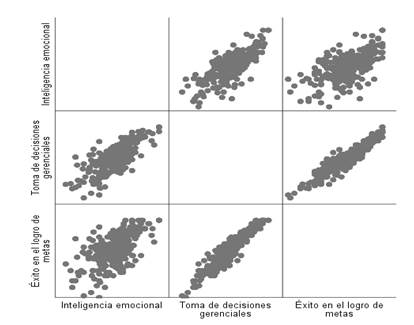 Figure 2.
Correlation test
Table 6 shows the validation of the measurement instruments for emotional intelligence, goal achievement, and managerial decision-making. The Kaiser-Meyer-Olkin coefficient, commonly known as KMO, yielded indicators greater than 0.7. Therefore, it can be concluded that the measurement instruments were statistically validated.
Table 6
Results of the exploratory factor analysis
|
Emotional intelligence |
Goal achievement |
Managerial decision-making |
Managerial decision-making |
||
|
Kaiser-Meyer-Olkin measure of sampling adequacy |
0.910 |
0.882 |
0.839 |
||
|
df |
Approx. chi-square |
24749.58 |
12753.61 |
6335.18 |
|
|
df |
435 |
648 |
28 |
||
|
p value |
0.000 |
0.000 |
0.000 |
||
Figure 3.
Initial model with standardized estimators
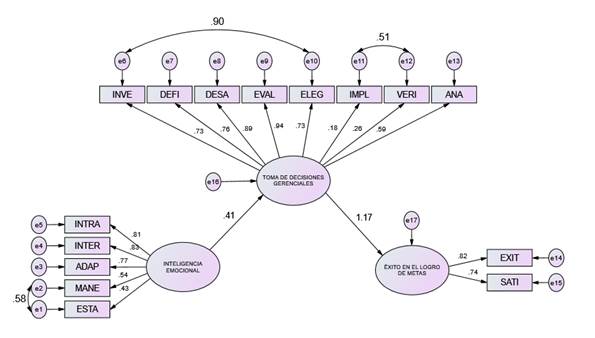
Figure 4
Final model
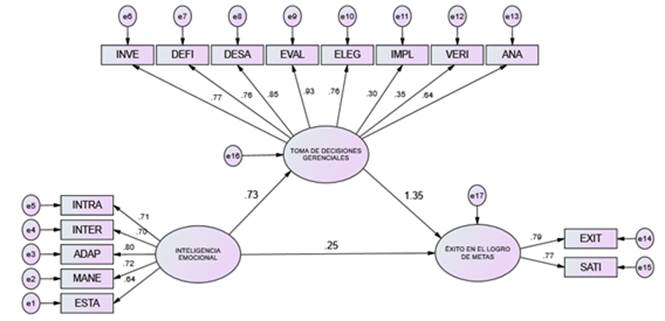
Table 7 presents the effects of the model. The strongest effect was that of managerial decision-making on success in goal achievement (β = 1.35; p < 0.01), followed by the effect of emotional intelligence on managerial decision-making (β = 0.73; p < 0.01), and finally the effect of emotional intelligence on success in goal achievement (β = 0.25; p < 0.01). The exogenous variables for each variable have an important effect on them, since all are significant in the model.
Table 7
Effects of emotional intelligence on managerial decision-making and its
effect on success in goal achievement.
|
|
|
|
S.E. |
C.R. |
P |
P |
|
Decision-making |
<--- |
Emotional intelligence |
0.728 |
0.049 |
20.034 |
*** |
|
SUCCESS |
<--- |
Decision-making |
1.35 |
0.025 |
36.04 |
*** |
|
SUCCESS |
<--- |
Emotional intelligence |
0.248 |
0.015 |
14.875 |
*** |
|
ESTA |
<--- |
Emotional intelligence |
0.637 |
0.029 |
20.323 |
*** |
|
MANE |
<--- |
Emotional intelligence |
0.722 |
0.029 |
22.885 |
*** |
|
ADAP |
<--- |
Emotional intelligence |
0.798 |
0.029 |
24.996 |
*** |
|
INTER |
<--- |
Emotional intelligence |
0.698 |
0.028 |
22.164 |
*** |
|
INTRA |
<--- |
Emotional intelligence |
0.707 |
0.025 |
28.7035 |
*** |
|
DESA |
<--- |
Decision-making |
0.853 |
0.022 |
35.243 |
*** |
|
EVAL |
<--- |
Decision-making |
0.931 |
0.017 |
39.542 |
*** |
|
ELEG |
<--- |
Decision-making |
0.755 |
0.017 |
30.379 |
*** |
|
IMPL |
<--- |
Decision-making |
0.303 |
0.013 |
11.338 |
*** |
|
EXIT |
<--- |
Success |
0.793 |
0.0175 |
23.1255 |
*** |
|
SATI |
<--- |
Success |
0.769 |
0.022 |
34.913 |
*** |
|
INVE |
<--- |
Decision-making |
0.77 |
0.0225 |
32.686 |
*** |
|
DEFI |
<--- |
Decision-making |
0.757 |
0.023 |
30.459 |
*** |
|
ANA |
<--- |
Decision-making |
0.638 |
0.013 |
25.027 |
*** |
|
VERI |
<--- |
Decision-making |
0.346 |
0.007 |
12.999 |
*** |
Table 8 shows that, in the final model, all beta parameters (β) are positive. Emotional intelligence has an effect on success in goal achievement (β = 0.25), which is explained by the instrument, in which each item has a direct formulation. Table 8 describes the goodness-of-fit of the structural equation model, indicating that the indices are acceptable. Therefore, the effects and relationships found are relevant for meeting the objectives and testing the hypotheses proposed in the research and may be generalized to similar populations. It is observed that GFI = 0.94, AGFI = 0.93, CFI = 0.94, IFI = 0.90, and TLI = 0.90 are all greater than 0.90. In addition, both RMR = 0.049 and RMSEA = 0.04 are lower than 0.05, and the X2 value = 3.51 falls within the standard range of 2 to 5. Compared with the initial model, whose values did not meet adequate goodness-of-fit standards, the results of the fit measures for the confirmatory factor analysis of the studied variables indicate that the data present a good model fit.
Table 8
Goodness-of-fit index of the final model
CFA model fit measures
|
Fit indicator statistics |
||
|
|
Initial model |
Final model |
|
Absolute fit measures |
||
|
X2 |
1429.44 |
1504. 63 |
|
GFI |
0.88 |
0.94 |
|
RMSEA |
0.093 |
0.04 |
|
NCP |
1211.39 |
1223.25 |
|
RFI |
0.8 |
0.82 |
|
ECVI |
1.12 |
1.58 |
|
RMR |
0.052 |
0.049 |
|
Incremental fit measures |
||
|
AGFI |
|
0.93 |
|
CFI |
0.86 |
0.94 |
|
IFI |
0.84 |
0.92 |
|
TLI |
0.87 |
0.91 |
|
NFI |
0.88 |
0.9 |
|
Parsimony fit measures |
||
|
X2 |
2.36 |
4.55 |
|
PNFI |
0.84 |
0.87 |
|
PGFI |
0.8 |
0.81 |
Note: Discrepancy value (X2), goodness-of-fit index (GFI), adjusted goodness-of-fit index (AGFI), root mean square residual (RMR), root mean square error of approximation (RMSEA), normed fit index (NFI), relative fit index (RFI), parsimonious goodness-of-fit index (PGFI), and parsimonious normed fit index (PNFI).
DISCUSSION
This section compares the main findings and implications of the study with the academic literature. The discussion focuses on establishing how previous academic research compares with the hypotheses of the present study.
The relationship between emotional intelligence and decision-making in achieving the goals of employees of SMEs in Lima, 2020, was determined, with a Pearson result of 0.830. This indicates that, within small companies in Lima, emotional intelligence is an important indicator for decision-making, considering that many companies may fail if they do not take care of their personnel and the emotional intelligence they manage. Regarding this result, Vidal (2018) reported an affirmative result in his study, with sig. < 0.05, determining a significant relationship between variables with a Spearman’s rho of 0.863. He emphasized that human beings are shaped by what they form in their minds, and that workers are constantly changing and facing situations in which emotions influence them. Therefore, they should possess good emotional intelligence so as not to negatively affect the company and so that correct decisions may be made for goal achievement. Mayta (2018) also highlights that emotional intelligence has a 73% influence on decision-making focused on fulfilling institutional objectives.
Likewise, the relationship between emotional intelligence and success in goal achievement among employees of SMEs in Lima, 2020, was determined, with a Pearson result of 0.755. This indicates that SMEs in the city of Lima should consider emotional intelligence as a success factor, since it affects or influences the fulfillment of institutional goals and achievements. In this regard, Álvarez (2019) reported a Spearman’s rho of 0.565, indicating a relationship between emotional intelligence and goal achievement. Márquez and Cerón (2019) also state that the dimensions of emotional intelligence are strong because they determine people’s behavior, affirming their relationship with success in the business context and noting that a company is much more likely to succeed when it has personnel who know how to guide their emotions and manage their activities professionally.
The results obtained from the model show a strong effect of managerial decision-making on success in goal achievement (β = 1.35; p < 0.01), indicating that its effect on success is highly important. In this regard, Miranda Viteri (2017) states that decision-making requires understanding the context in which the company operates, because decisions can lead the organization either to failure or success; this author also determined a considerable relationship and influence with p < 0.05. The effect of emotional intelligence on managerial decision-making was also considered (β = 0.73; p < 0.01), and the application of the equation model demonstrated an important and high effect. In this sense, Horna (2005) states that decision-making is a process through which people attempt to change the course of events in their effort to achieve goals that provide well-being, prosperity, and ultimately happiness. Robbins and Timothy (2009) argue that decision-making is based on selecting one option among two or more alternatives for solving a problem; therefore, decision-makers must use rationality when choosing among options, that is, selecting the most consistent and highest-value option.
Finally, the model confirmed that the effect of emotional intelligence on success in goal achievement (β = -0.25; p < 0.01) is significant. Regarding the influence of both variables, Silva (2016) confirms the existence of an influence of emotional intelligence on goal achievement. Horna (2005) notes that the best formula for success is not reason alone, but a combination of reason and emotion. For Abraham Maslow (1991), emotional intelligence can be understood as intelligence for success; decision-making has the same purpose: to achieve success, solve problems, and generate well-being, prosperity, and happiness, specifically through goal achievement.
A limitation of this study was its inability to reach all SMEs in the city of Lima. However, the sample size obtained provides considerable results. Future studies should address communities or more specific environments.
The contribution of this study is to confirm the interconnection between emotion and cognition, that is, between the emotional mind and the cognitive mind, particularly in decision-making, where both function synergistically toward goal achievement. The benefits of this research will directly affect the SMEs involved, their managers, and their personnel, and indirectly benefit suppliers, consumers, and the community as a whole. Through its statistical results, this study also provides an important contribution for SMEs, entrepreneurs, university students, and research faculty working on emotional intelligence and job performance. It may help improve relationships among workers and, consequently, foster a more empathetic work environment, better customer service, and more effective resolution of labor conflicts. Economically, it may contribute to increased income, higher profitability, and better investment opportunities, among other benefits.
CONCLUSIONS
It is recommended that SMEs in the city of Lima carry out activities that strengthen workers’ emotional intelligence, while also analyzing each employee’s situation and providing the necessary support.
It is also recommended that SMEs form alliances and jointly hire a psychology specialist who can assist workers when needed, with the aim of ensuring that employees are prepared to perform the duties assigned to them.
SMEs are encouraged to establish a work plan for workshops focused on emotional intelligence topics, such as emotional control and occupational mental health, including exercises that allow workers to reduce stress generated by unfavorable situations within the organization.
Likewise, it is recommended to design a well-founded Emotional Intelligence Program aimed at optimizing the quality of service provided by company personnel.
It is recommended that managers hold periodic meetings to evaluate the results of decisions made.
For future research, it is also proposed to study decision-making strategies and how they affect the productivity of micro and small enterprises, specifically in the agricultural trade sector. This research includes updated theories, concepts, and data with the purpose of contributing to improvements in emotional intelligence and job performance. It may also serve as a reference for subsequent studies and research in this area.
Author statement: The authors approve the final version of the article.
Conflict of interest statement: The authors declare that they have no conflict of interest.
Author contributions:
- Conceptualization: José Tarrillo Paredes
- Data curation: Sandrita Aracely Huamán Moreto
- Formal analysis: José Eber Paz Vilchez
- Research: José Tarrillo Paredes
- Methodology: José Eber Paz Vilchez
- Writing: Sandrita Aracely Huamán Moreto
Funding: This work received no funding.
REFERENCES
Antúnez, A. M. C., Morales, C. E. B., & Araujo, D. R. S. (2019). La sostenibilidad global en una empresa de transporte urbano de viajeros en autobús: Estudio de caso. In Memorias del III Congreso internacional en administración de negocios internacionales (CIANI): Retos y oportunidades del desarrollo sostenible en los negocios internacionales (pp. 28-42). Universidad Pontificia Bolivariana.
Arrieta, L. E., & Morales, C. E. B. (2024). Necesidades sociales y dimensiones del capital social: análisis de beneficiarios de Familias en Acción. Telos: Revista de Estudios Interdisciplinarios en Ciencias Sociales, 26(2), 388-407.
Barrera, M. B., & Morales, C. E. B. (2025). Análisis de la percepción de la cultura tributaria en Colombia durante el periodo pospandemia. Dictamen Libre, (36), 2.
Bermúdez Villarroya, K., Bermúdez Bueno, W., & Miranda Passo, J. (2021). Cuidados paliativos: un procedimiento médico regulado por el ordenamiento jurídico colombiano. Mare Ingenii, 3(2), 43–59. https://doi.org/10.52948/mare.v3i2.565
Borja-Barrera, M., & Barragán-Morales, C. (2025). Perception analysis of tax culture in Colombia during the post-pandemic period. Dictamen Libre, (36).
Castro, J., Castellanos, E., Fonseca, L., & Lugo, J. (2019). Una mirada al capital intelectual en universidades públicas. Revista Scientific, 4(13), 90–113. https://doi.org/10.29394/Scientific.issn.2542-2987.2019.4.13.5.90-113
Cayetano Saldaña, P. J. (2015). Condiciones laborales y el desempeño de los colaboradores en la Financiera EDYFICAR - Chimbote: 2014. Universidad Nacional de Trujillo, 108.
Chiavenato, I. (2007). Administración de recursos humanos (M. McGraw-Hill., Ed.).
Cook, R. D., & Weisberg, S. (1982). Residuals and Influence in Regression. In Journal of the Royal Statistical Society. Series A (General) (Vol. 147, Issue 1). Chapman y Hall. https://doi.org/10.2307/2981746
Cruz, I., & Vargas, A. (2017). Inteligencia emocional y desempeño laboral en docentes del Gimnasio Nueva América. Repositorio Institucional, 133.
Cuevas, R., García-Calvo, T., & Contreras, O. (2013). Perfiles motivacionales en educación física: Una aproximación desde la teoría de las metas de logro 2×2. Anales de Psicología, 29(3), 685–692. https://doi.org/10.6018/analesps.29.3.175821
Delfín Álvarez, G. M. (2019). Taller de inteligencia emocional para mejorar las relaciones interpersonales en estudiantes del quinto grado de educación primaria de la I.E N° 80050 José Félix Black-Paiján. Universidad Nacional de Trujillo.
El Economistamerica.pe. (2019). El índice promedio de rotación laboral llega a 20,7% en las empresas peruanas. Eleconomistaamerica.Pe.
Espitia-Arrieta, L., Tatiana Prestan-Gómez, S., & Barragán-Morales, C. (2022). Programas de transferencias monetarias condicionadas: una comparación en América Latina frente a Familias en Acción. Dictamen Libre, (31).
Esteban Mayta, M. E. (2018). Talleres de inteligencia emocional para mejorar el servicio de atención al público en la UAP Filial Huancayo 2018. Universidad César Vallejo.
Fuentes, Y. S. (2014). Manejo de la inteligencia emocional como factor determinante para lograr un alto nivel de desarrollo social en los niños. 1–127.
Garza Toledo, E., Garabito Ballesteros, G., Hernández, J., Rodríguez Gutiérrez, J., & Olivo Pérez, M. (2009). Hacia un concepto ampliado de control y relación laboral. Iztapalapa: Revista de Ciencias Sociales y Humanidades, 66, 17–52.
Goleman, D. (1999). La práctica de la inteligencia emocional (F. Mora & D. González Raga, Eds.; Primera Ed). Editorial Kairo’s. https://doi.org/117-121-08029
Hair, J. F., Anderson, R. E., Tatham, R. L., & Black, W. C. (1999a). Analysis multivariate. In Prentice Hall (5ta Edición, Vol. 53, Issue 9). https://doi.org/10.1017/CBO9781107415324.004
Hair, J. F., Anderson, R. E., Tatham, R. L., & Black, W. C. (1999b). Análisis multivariante. In Prentice Hall (5ta Edición, Vol. 53, Issue 9). https://doi.org/10.1017/CBO9781107415324.004
Hernández Sampieri, R. (2014). Metodología de la investigación (6a edición).
Hernández-Lahoz Ortiz, P. (2016). Derecho social Internacional y Comunitario. Revista Del Ministerio de Empleo y Seguridad Social, 122(2254–3511), 1–330.
Horna Figueroa, E. (2005a). Relación entre la inteligencia emocional, la toma de decisiones y el éxito en el logro de metas en los estudios y el trabajo. Universidad Nacional de Trujillo.
Horna Figueroa, E. (2005b). Relación entre la inteligencia emocional, la toma de decisiones y el éxito en el logro de metas en los estudios y el trabajo. Universidad Nacional de Trujillo.
Huamán. (2012). La importancia de la información para la toma de decisiones en la empresa. https://blog.corponet.com.mx/la-importancia-de-la-informacion-para-la-toma-de-decisiones-en-la-empresa
Kenia silva, J. P. (2016). relación entre la inteligencia emocional y el desempeño laboral de los trabajadores de la empresa novedades B&V. de la ciudad de Trujillo en el periodo 2016. 105.
Kline, R. B. ; (2011). Principales and practice of Structural Equation Modelling. In The Guilford Press (Third Edit). https://doi.org/10.1017/CBO9781107415324.004
Ley, C., Ley, C., Klein, O., Bernard, P., & Licita, L. (2013). Detecting outliers: Do not use standard deviation around the mean, use absolute deviation around the median. Journal of Experimental Social Psychology, 49(4), 764–766. https://doi.org/10.1016/j.jesp.2013.03.013
Maslow, A. H. (1991). Motivación y personalidad (J. Bravo, Ed.; Ediciones).
Miranda Morales, J. C., Maldonado Pastor, S., & González Mejía, X. (2023). Desfragmentación social y transmisión intergeneracional de desigualdades educativas en jóvenes colombianos. Pensamiento Americano, 16(31), 1-18. https://doi.org/10.21803/penamer.16.31.582
Miranda Viteri, M. del P. (2017). inteligencia emocional según género en adolescentes de 13 a 16 años de una institución educativa de la ciudad de Cajamarca - 2017. Nivel De Satisfacción Del Adulto Mayor Ante El Cuidado Humanizado Que Brindan Las Enfermeras Del Centro De Salud Quiñones Gonzáles Chiclayo 2017., 82.
Molero, G. (2016). La responsabilidad social empresarial en el contexto del capital social Corporate Social Responsibility in the Contexto of Social Capital. Revista Ominia, 22(3), 46–59.
Morales, C. E. B., Mendoza, A. P., Barrera, M. B., & Osorio, F. M. (2024). Transformational leadership and decision-making in organizations of the Colombian Caribbean. Dictamen Libre, (34), 167-178.
Morales, C. E. B., Guarín-García, A. F., Chang-Muñoz, E. A., Villanueva-Vásquez, A., Gálvez, J. F. E., Delgado, N. A. G., & Bracho, O. C. (2025). Fuzzy-Set Qualitative Comparative Analysis to Corporate Social Responsibility Components: A Case Study from Media Print Companies in Atlántico Department of Colombia. Procedia Computer Science, 257, 1148-1153.
Morales, C. E. B., De Moya, F. E. M., Vélez, N. S., & Vargas, E. C. (2023). Innovación social: Una aproximación desde su relación con la responsabilidad social empresarial en tiempos del COVID 19. In Investigación y Desarrollo (pp. 137-150). Fondo Editorial CIIDIES.
Mudarra-Fernández, A. B., Barragán-Morales, C. E., & González-Beleño, C. (2023). La eficiencia de las empresas con marca en los hoteles de las Ciudades Patrimonio de la Humanidad consolidadas de España. Revista Ibérica de Sistemas e Tecnologias de Informação, (E60), 624-636.
Pallant, J. (2011a). SPSS Survival Manual. In Allen & Unwin (4ta Editio). https://doi.org/10.1046/j.1365-2648.2001.2027c.x
Pallant, J. (2011b). SPSS Survival Manual. In Allen & Unwin (4ta Editio). https://doi.org/10.1046/j.1365-2648.2001.2027c.x
Pereda Pérez, F., López-Guzmán, T., & González Santa Cruz, F. (2018). La inteligencia emocional como habilidad directiva. Estudio aplicado en los municipios de la provincia de Córdoba (España). Noesis, 27(0188–9834), 1–25. https://doi.org/http://dx.doi.org/10.20983/noesis.2018.1.5
Remigio Vidal, R. (2018). La inteligencia emocional y la autoestima en estudiantes de V ciclo del nivel primaria en la I.E Carlos Martínez Uribe Huaral – 2017. Universidad César Vallejo.
Rincones Avendaño, D. A. . (2020). La resocialización en Colombia: un estudio desde la carcel distrital rodrigo de bastidas. Pensamiento Americano, 13(25), 101-120. https://doi.org/10.21803/pensam.13.25.395
Rivera-Vargas, P., & Lindín, C. (2018). Tecnologías digitales para transformar la sociedad. Universidad de Barcelona, 1(978–84–17238–97–1), 1–163.
Robbins, S. P., & Timothy A, J. (2009). Comportamiento Organizacional (J. E. Brito, Ed.; Decimo ter).
Saunders, M., Lewis, P., & Thornhill, A. (2013). Research methods for business students. In International Journal of the Historfile:///Users/maribelparedes/Desktop/Captura de pantalla 2020-12-10 a la(s) 21.04.36.pngy of Sport (5ta., Vol. 30, Issue 1). https://doi.org/10.1080/09523367.2012.743996
Soriano Márquez, A. de J., & Díaz Cerón, A. M. (2019). La inteligencia emocional como factor importante en el liderazgo. Ciencia Administrativa2, 1(1870–9427), 87–92.
Tabachnick, B. G., & Fidell, L. S. (2013a). Using Multivariate Statistics. In Inc. Pearson Education (Ed.), Pavithra Jayapaul/Jouve (6ta Edició). Pearson Education, Inc. https://doi.org/10.1037/022267
Tabachnick, B. G., & Fidell, L. S. (2013b). Using Multivariate Statistics. In Inc. Pearson Education (Ed.), Pavithra Jayapaul/Jouve (6ta Edició). Pearson Education, Inc. https://doi.org/10.1037/022267
Turizo, J. M., Bracho, O. C. C., & Morales, C. B. (2026). General and differential mechanisms of citizen participation: Prior consultation and victims’ participation boards. Pensamiento Americano, 19(39).
Velasquez Castro, V., Suarez Zambrano, P., Serrano Mantilla, H., & Yance Carvajal, C. (2016). La inteligencia emocional y su influencia en la gestión personal y productiva de los microempresarios / Emotional intelligence and its influence on the personal and production management microentrepreneurs. Ciencia Unemi, 9(18), 81. https://doi.org/10.29076/issn.2528-7737vol9iss18.2016pp81-89p
Yabar Bornaz, K. (2016). Niveles de inteligencia emocional y desempeño laboral en el personal de salud administrativo de la Microred La Molina - Cieneguilla. Universidad San Martín de Porres.
Yserm, L. (2016). relacion entre la inteligencia emocional recursos y problemas psicologicos, en la infancia y adolescencia.