Nearshoring in Colombia: Strategies for Business Internationalization and Economic Development
Nearshoring na Colômbia: Estratégias para a internacionalização das empresas e o desenvolvimento económico
El nearshoring en Colombia: estrategias para la internacionalización empresarial y el desarrollo económico
DOI: https://doi.org/10.57188/rieca.2026.009
Roberto Morales Espinosa * ORCID: https://orcid.org/0000-0003-0785-5522
Yulis Patricia Quintero Castilla
Daniel Felipe Palacios Cuero
Universidad Libre, Faculty of Economic, Administrative, and Accounting Sciences. Barranquilla, Colombia
How to cite:
Morales, R., Quintero, Y. y Palacios, D. (2026). Nearshoring in Colombia: Strategies for Business Internationalization and Economic Development. RIECA, 1(1). e-9. https://doi.org/10.57188/rieca.2026.009
ABSTRACT
This study analyzes the impact of nearshoring in Colombia, where multinational companies relocate their supply chains closer to their main markets. The COVID-19 pandemic and trade tensions between the United States and China have positioned Colombia as a potential destination, given its geographic advantages and free trade agreements. The study evaluates the opportunities and challenges of nearshoring for Colombian companies, including the attraction of foreign investment, lower logistics costs, and increased global competitiveness. It also examines challenges related to infrastructure, human capital, and government policies. Using a qualitative approach based on case studies and a literature review, the study identifies key elements for maximizing the positive impact of nearshoring and promoting the international expansion of Colombian firms. This study contributes to the debate on post-pandemic internationalization strategies in Latin America and offers a framework for future research.
Keywords: Nearshoring; internationalization; Colombian firms; supply chains; foreign investment; post-pandemic.
JEL Code: F23; F10; L21; L14; F21; O54.
RESUMO
Este estudo analisa o impacto do nearshoring na Colômbia, onde empresas multinacionais transferem suas cadeias de suprimentos para locais mais próximos de seus principais mercados. A pandemia da COVID-19 e as tensões comerciais entre os Estados Unidos e a China posicionaram a Colômbia como um destino em potencial, dadas suas vantagens geográficas e acordos de livre comércio. O estudo avalia as oportunidades e os desafios do nearshoring para as empresas colombianas, incluindo a atração de investimento estrangeiro, a redução dos custos logísticos e o aumento da competitividade global. Ele também examina desafios relacionados à infraestrutura, capital humano e políticas governamentais. Utilizando uma abordagem qualitativa baseada em estudos de caso e uma revisão da literatura, o estudo identifica elementos-chave para maximizar o impacto positivo do nearshoring e promover a expansão internacional das empresas colombianas. Este estudo contribui para o debate sobre estratégias de internacionalização pós-pandêmicas na América Latina e oferece um marco para pesquisas futuras.
Palavras-chave: Nearshoring; internacionalização; empresas colombianas; cadeias de abastecimento; investimento estrangeiro; pós-pandemia.
INTRODUCTION
Nearshoring has gained relevance in the reconfiguration of global supply chains, driven by the COVID-19 pandemic and trade tensions between the United States and China. The pandemic not only reshaped global supply chains, but also generated significant impacts across different economic sectors, including reductions in income, employment, and business operating capacity (Aquino Rocha et al., 2021). This strategy, which consists of relocating operations closer to main markets, has emerged as a solution for multinational companies seeking to optimize logistics costs and improve the resilience of their supply chains. In this context, Latin America has become a key region for nearshoring, with countries such as Mexico, Brazil, and Colombia competing to attract foreign investment. Colombia, in particular, has gained attention as an emerging destination due to its strategic geographic location, access to two oceans, and network of free trade agreements. Although Mexico has traditionally been favored because of its proximity to the United States, Colombia is positioned as an attractive option for companies seeking to diversify their operations in the region.
Nevertheless, although nearshoring presents multiple opportunities for the internationalization of Colombian companies, it also poses significant challenges. Deficiencies in logistics infrastructure, high levels of bureaucracy, and the lack of specialized human capital are among the main obstacles limiting the ability of domestic firms to compete in international markets. In this context, the following question arises: How can Colombian companies overcome structural and infrastructure challenges in order to capitalize on the opportunities offered by nearshoring in their internationalization process?
This problem calls for an analysis of how Colombian companies can adjust their operational strategies, optimize their supply chains, and collaborate with the public sector to improve the conditions needed for successful nearshoring. It also highlights the need to explore the role of public policies in improving infrastructure, simplifying regulatory processes, and creating training programs that strengthen technical capabilities. In this way, Colombian companies could be better positioned to take advantage of the country's geographic and commercial advantages, increasing their competitiveness and facilitating their expansion into key markets such as the United States and Europe.
The objective of this article is to analyze the opportunities and challenges that nearshoring presents for the internationalization of Colombian companies, evaluating how they can leverage this trend to expand into global markets. In addition, the article examines the impact of nearshoring on the post-pandemic strategies of local companies, identifying the factors that could enhance or limit their success. This approach seeks not only to understand the challenges, but also to propose practical and collaborative solutions between the private and public sectors so that Colombia can consolidate itself as a strategic nearshoring hub in the region.
METHODOLOGY
This study is based on a qualitative approach that combines case analysis and documentary review to examine the opportunities and challenges of nearshoring in Colombia. A case analysis will be conducted of companies in Latin American countries that have already implemented or are exploring nearshoring strategies. These cases will serve to identify success factors and the main obstacles faced in international expansion, providing a more detailed view of business dynamics in Colombia. The research will also include a documentary review of secondary sources, such as reports from international institutions and academic studies on supply chains and relocation in Latin America. These documents will complement the analysis with data on global trends and the regional context. Finally, a SWOT analysis (Strengths, Weaknesses, Opportunities, and Threats) will be applied to assess Colombia's competitive position in relation to nearshoring. This approach will make it possible to identify the country's advantages, the challenges it must overcome, and the opportunities it could capitalize on in the global market.
RESULTS
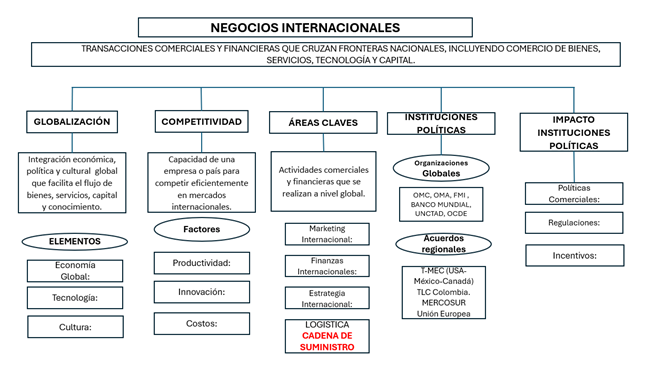
Nearshoring is examined through the lens of the main theories of internationalization (Figure 1), the reconfiguration of global supply chains (Figures 2 and 3), and nearshoring itself (Figure 4), with a focus on the dynamics of the Colombian and Latin American context.
First, theories of internationalization provide a conceptual basis for understanding the strategic decisions of Colombian firms in their international expansion. According to Cardozo, Chavarro, and Ramírez (2007), internationalization is a complex process that has been approached from various theoretical perspectives, each with different explanations of how and why companies expand into international markets. They cite David Ricardo, whose Theory of Comparative Advantage holds that countries should specialize in producing goods in which they have a relative advantage and can produce at lower cost. They also refer to the Uppsala Model, developed by Johanson and Vahlne in 1977, which describes internationalization as a gradual process in which firms first expand their operations to geographically close markets, accumulating knowledge and experience.
They also refer to John Dunning's Eclectic Paradigm (OLI), which suggests that firms internationalize when they can combine three types of advantages: ownership (O), location (L), and internalization (I). They also highlight the Internationalization Theory based on Coase's transaction costs, which indicates that firms expand into foreign markets to minimize the costs of operating in these contexts. Finally, they cite the Resource-Based View, which argues that internationalization is undertaken to exploit a firm's unique resources and capabilities in new markets, enabling better use of its competitive advantages.
Nearshoring can be viewed as an extension of these strategies, allowing Colombian firms to integrate into closer and more resilient global supply chains. In a volatile post-pandemic environment, companies are reconfiguring their operations to reduce risks and improve operational efficiency (Figure 4).
According to the World Economic Forum (2023), nearshoring consists of moving operations to a nearby country with a similar time zone, taking advantage of the experience and knowledge of the local workforce. This makes it possible to speed up delivery times and achieve greater economic certainty. It is a competitive strategy that relies on the productivity of the global logistics chain and international trade, seeking to reduce costs and risks through nearby locations.
Medina Ariza (2024) highlights how nearshoring is transforming industry and trade in Latin America. This model, which involves relocating business operations to nearby countries, has gained relevance because of the trade war between China and the United States, the pandemic, and other factors. Latin America, especially Mexico, is presented as an attractive destination for nearshoring, with benefits such as shorter delivery times, lower costs, and increased production. According to Mejía (2024), nearshoring is a business strategy that involves relocating operations closer to consumer markets in order to reduce costs, shorten delivery times, and mitigate risks in the global supply chain.
Supply chain management theories help explain how nearshoring can optimize logistics and improve responsiveness to international markets while increasing business competitiveness. In this regard, Pulido (2014) defines the supply chain as the activities that transform goods from raw materials to the final consumer. Krawjesky et al. (2008) describe it as a network of services, materials, and information flows that connects suppliers and customers. Ballou (2004) adds that logistics, as part of this chain, includes transportation and repeated inventory control through final delivery. In terms of management, López (2008) and Chase et al. (2009) agree that it involves managing resources to meet the company's strategic priorities. Complementarily, knowledge management makes it possible to articulate organizational processes and strengthen strategic decision-making in competitive and international environments (Martínez Garcés & Garcés Fuenmayor, 2021).
Studies on business relocation in Latin America highlight the region's potential to adapt to nearshoring dynamics. Although countries such as Mexico have been at the forefront of this phenomenon, Colombia is emerging as a key competitor. This is aligned with new post-pandemic internationalization strategies that seek not only to improve the competitiveness of local companies, but also to attract foreign investment by taking advantage of the country's strategic location and trade agreements.
In this context, the business models and competitiveness of Colombian firms are crucial factors. Their ability to adapt to nearshoring requirements depends on their capacity to implement advanced technologies, improve logistics infrastructure, and train specialized human capital. In this regard, innovative leadership becomes a key element for strengthening organizational cultures oriented toward innovation and adaptation to dynamic environments, thereby fostering business competitiveness (Fontalvo & Cienfuegos Molina, 2020). These capabilities will allow companies to participate actively in regional nearshoring dynamics and take advantage of the opportunities offered by this phenomenon.
Figure 1.
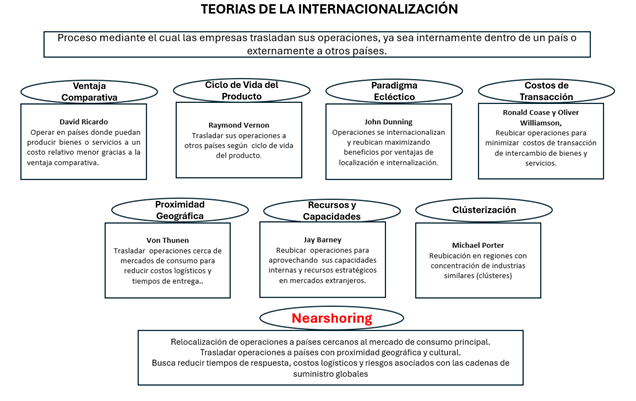 |
Theories of internationalization.
Source: Author's own elaboration.
Figure 2.
Supply chains in international business
 |
Source: Author's own elaboration.
Figure 3.
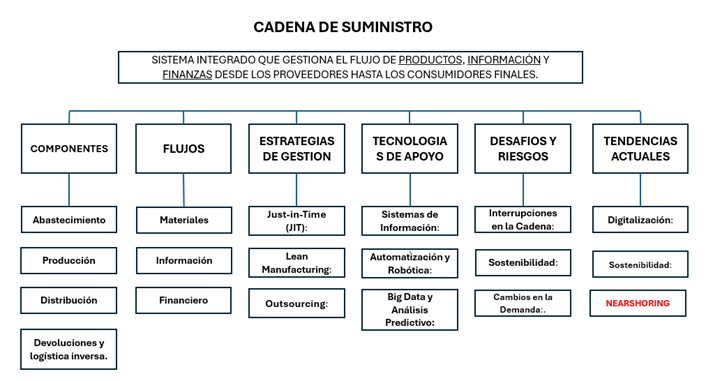 |
Supply chains: Key elements
Source: Author's own elaboration.
Figure 4
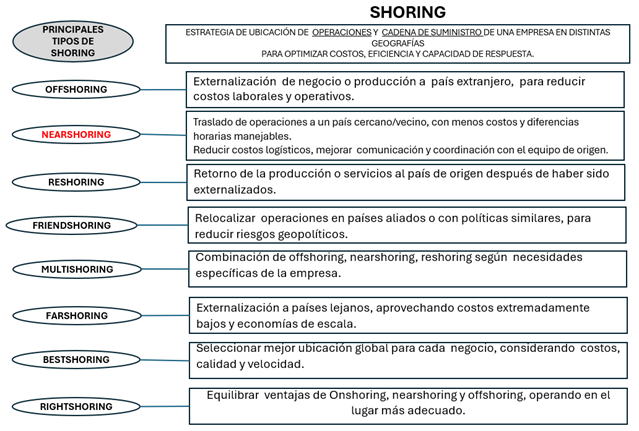
Nearshoring in
the context of shoring
Source: Author's own elaboration.
Latin American context.
In recent years, nearshoring has gained momentum as a key strategy for the reconfiguration of global supply chains, especially in Latin America. This trend, which involves relocating operations closer to major consumer markets, has enabled multinational companies to optimize costs, improve logistics efficiency, and reduce their dependence on Asia. Countries such as Mexico, Costa Rica, Colombia, Brazil, Argentina, and Chile have positioned themselves as attractive destinations for this modality, each with specific strengths and sectors in which it stands out.
Despite differences among countries, common factors have facilitated the success of nearshoring in Latin America, including geographic and cultural proximity to the United States, favorable trade agreements, skilled labor, and competitive costs. In addition, investment in logistics and digital infrastructure has been crucial for attracting investment and consolidating the region as a strategic hub for the relocation of operations.
In the post-pandemic context, nearshoring has consolidated itself as a viable option for companies seeking to mitigate risks and diversify their supply chains. This phenomenon offers Latin American countries a unique opportunity to increase their global competitiveness, provided they are able to overcome challenges such as infrastructure deficiencies and bureaucratic barriers. In this context, various studies have shown that the pandemic caused substantial reductions in income and employment in productive sectors, forcing companies to rethink business strategies and strengthen organizational resilience (Aquino Rocha et al., 2021).
The following examples present successful nearshoring cases in Latin America, illustrating how various companies have used the region's advantages to strengthen their presence in international markets. From the automotive industry in Mexico to the technology services sector in Argentina and Chile, as well as the expansion of BPO in Colombia and the development of the pharmaceutical industry in Brazil, nearshoring has proven to be an effective tool for promoting foreign investment and economic growth in the region.
Mexico, the main nearshoring destination in the Americas, has been a key location for the nearshoring of automotive companies, especially from the United States. Major brands such as Ford, General Motors, and Tesla have transferred parts of their manufacturing processes to Mexico. The United States-Mexico-Canada Agreement (USMCA) has been a key facilitator, providing a tariff-free trade framework that promotes relocation. In the electronics sector, companies such as Foxconn, which manufactures electronic products including Apple components, have relocated part of their production to Mexico, seeking to take advantage of proximity to the United States and reduce dependence on Asia, especially after trade tensions between the United States and China (C. Garrido, 2022).
In Costa Rica, nearshoring has developed in the technology and services sectors. In 2020, Intel announced a significant investment to reactivate one of its assembly and testing plants in Costa Rica, an operation that had closed in 2014. This investment was partly motivated by a nearshoring strategy aimed at diversifying its supply chain and being closer to its key markets in North America.
In shared services and BPO, Costa Rica has become an attractive destination for global companies' shared services centers and business process outsourcing operations. Companies such as Amazon and HP have operations centers there, taking advantage of the skilled workforce and strategic location in the Western Hemisphere.
Colombia has become one of the emerging destinations for nearshoring in the Business Process Outsourcing (BPO) and information technology sectors. Companies such as Teleperformance, Sitel, and Concentrix have expanded their operations in Colombia due to the availability of bilingual talent and proximity to the United States. The pandemic accelerated demand for customer service operations, which Colombia has been able to capitalize on. In 2021, Tata Consultancy Services (TCS), an Indian technology multinational, expanded its presence in Colombia as part of its strategy to provide IT services to North America and Latin America, using Colombia as a strategic center.
In Brazil, the French pharmaceutical company Sanofi has consolidated part of its production to supply Latin American markets. Although its operation is focused mainly on the Brazilian market, this decision is also part of a nearshoring strategy to reduce transportation costs and increase efficiency in the supply of medicines throughout the region. In turn, the German pharmaceutical and biotechnology multinational Bayer has also invested in production in Brazil, particularly in agricultural products such as pesticides and genetically modified seeds, to serve regional markets.
Similarly, in Argentina, Globant, the Argentine software development company, has been a successful example of nearshoring in the technology sector. It has created a model of innovation centers in Latin America, from which it offers technology services to clients in the United States and Europe. This strategy has allowed Globant to take advantage of cost differences while maintaining a high level of quality and proximity to international clients. MercadoLibre, although not strictly a nearshoring company, has consolidated logistics centers in Argentina and other Latin American countries to optimize its supply chain in the region, serving local markets and exporting products within the region.
Finally, in Chile, multinationals such as IBM and Accenture have established development and support centers, taking advantage of the country's economic stability and advanced digital infrastructure. These centers provide technology and consulting services to clients in North America and Europe. Likewise, in 2021, Falabella, the Chilean retail company, announced an alliance with Amazon Web Services (AWS) to launch its cloud technology services platform, strengthening the infrastructure for digital and technological nearshoring in the region.
From the cases discussed above, the key success factors for nearshoring in the Americas include geographic and cultural proximity, favorable trade agreements and fiscal policies, skilled labor and competitive costs, and investment in infrastructure. Regarding the first factor, proximity to the United States and time-zone alignment facilitate operational coordination, particularly in the services sector. Regarding the second factor, countries such as Mexico, Costa Rica, and Colombia have developed attractive fiscal policies and trade agreements that favor foreign direct investment. As for the third factor, the availability of qualified talent, particularly in the IT and manufacturing sectors, combined with lower labor costs than in the United States or Europe, makes the region competitive. Finally, regarding the fourth factor, countries that have developed solid logistics and digital infrastructure have been able to attract more nearshoring investment.
Analysis of the Colombian context
The SWOT analysis of nearshoring in Colombia makes it possible to assess both the advantages and the challenges the country faces in positioning itself as an attractive destination for the relocation of business operations. Among its strengths are its strategic geographic location, close to the United States and the Panama Canal, which facilitates access to key markets in North America, the Caribbean, and Europe. In addition, Colombia has multiple free trade agreements that allow exports with reduced tariffs, as well as competitive labor costs and growth in technological infrastructure that supports sectors such as technology and value-added services.
In this context, nearshoring also presents important opportunities, such as attracting foreign direct investment (FDI) in sectors including manufacturing, technology, and services, which would strengthen export capacities and generate quality employment. Likewise, the nearshoring trend could drive economic diversification, the development of emerging sectors, and improvements in logistics and transport infrastructure. The growth of e-commerce and government incentives also create a favorable environment for attracting investment, reducing dependence on traditional markets.
However, the country faces significant weaknesses, such as deficient logistics infrastructure in key areas, which limits efficiency and increases transportation costs. These limitations can be interpreted as structural constraints affecting business growth that must be identified and managed to improve organizational performance (Rodríguez, 2021). Bureaucratic barriers and regulatory instability also discourage foreign investment. In addition, the lack of skilled labor in strategic sectors and dependence on traditional sectors such as oil and mining hinder the transition toward a more diversified economy oriented toward nearshoring. Challenges related to insecurity and regional inequality are also present.
In this scenario, threats include competition from countries such as Mexico and Brazil, which have more developed infrastructure and experience in manufacturing, potentially affecting Colombia's positioning as a nearshoring destination. Political and economic uncertainty, together with limitations in energy and transport supply, represent additional risks for companies considering relocation to the country. Security problems and social conflicts also negatively influence the perception of stability and security for foreign investment (Sandoval et al., 2020; Andino, 2023).
In conclusion, nearshoring offers Colombia a unique opportunity to increase its competitiveness in the global market, but its success will depend on the country's ability to overcome structural weaknesses, improve logistics infrastructure, and create a stable political and economic environment. Addressing these challenges will be essential to maximizing the benefits of this strategy and positioning Colombia as an attractive destination for the relocation of business operations.
TABLE 1.
Swot analysis of nearshoring in Colombia Strengths
|
Strategic Geographic Location: |
Colombia is strategically located near the United States and the Panama Canal, facilitating access to key markets in North America, the Caribbean, and Europe. |
|
Free Trade Agreements: |
The country has multiple trade agreements that allow companies to export to important markets with reduced or zero tariffs, including the United States, the European Union, and several Latin American countries. |
|
Competitive Labor Costs: |
Colombia offers skilled labor at relatively low costs compared with other countries in the region, making it attractive for companies seeking to optimize costs. |
|
Growth in Technological Infrastructure: |
Technological and digital infrastructure in the country has increased, supporting sectors such as technology and value-added services.
|
OPPORTUNITIES
|
Attraction of Foreign Direct Investment (FDI): |
Nearshoring can attract investment in sectors such as manufacturing, technology, and services, strengthening export capacities and creating quality jobs. |
|
Development of New Sectors: |
There are opportunities to develop emerging sectors such as technology, financial services, and advanced manufacturing, which can benefit from the nearshoring trend. |
|
Economic Diversification: |
Taking advantage of nearshoring can help diversify the Colombian economy by reducing its dependence on traditional sectors such as natural resources. |
|
Infrastructure Improvement: |
The nearshoring trend could drive investment in logistics and transport infrastructure, improving domestic connectivity and the country's competitiveness. |
|
E-commerce growth: |
Increased demand for logistics and technology services. |
|
Government incentives: |
Favorable policies to attract foreign investment. |
|
Market diversification: |
Reduced dependence on traditional markets. |
WEAKNESSES
|
Deficient Logistics Infrastructure: |
Despite progress, deficiencies persist in road, port, and airport infrastructure, limiting logistics efficiency and increasing transportation costs. |
|
Bureaucratic and Regulatory Barriers: |
Bureaucratic complications and regulatory instability can discourage foreign investment and hinder the operation of companies seeking to relocate to Colombia. |
|
Lack of Skilled Labor: |
Insufficient specialized workers in key sectors may limit the country's ability to attract technology and advanced manufacturing industries. |
|
Dependence on Traditional Sectors: |
The Colombian economy still depends heavily on traditional sectors such as oil and mining, which may hinder the transition toward a more diversified economy oriented toward nearshoring. |
|
Insecurity: |
Security problems that may affect the perception of stability. |
|
Regional inequality: |
Significant differences in development among regions. |
THREATS
|
Regional and International Competition: |
Countries such as Mexico and Brazil, with greater advances in infrastructure and manufacturing experience, may represent strong competition for Colombia as a nearshoring destination. |
|
Political and Economic Uncertainty: |
Uncertainty in the political landscape and economic fluctuations can create a risky environment for foreign investors. |
|
Energy and Transport Limitations: |
Restrictions in energy supply and problems in transport infrastructure could hinder industrial development and business operations in certain regions of the country. Security and Stability Risks: Security problems in some areas of the country and social conflicts may affect the perception of Colombia as a safe destination for investment and business relocation. |
|
Economic fluctuations: |
Impact of the global economy on investment and trade. |
|
Climate change: |
Risks associated with natural disasters and their impact on infrastructure. |
Table 2.
Final swot summary of nearshoring in colombia
|
STRENGTHS |
OPPORTUNITIES |
|
Strategic Geographic Location Free Trade Agreements Competitive Labor Costs Growth in Technological Infrastructure
|
Attraction of Foreign Direct Investment (FDI) Development of New Sectors Economic Diversification Infrastructure Improvement E-commerce growth Government incentives Market diversification |
|
WEAKNESSES |
THREATS |
|
Deficient Logistics Infrastructure Bureaucratic and Regulatory Barriers Lack of Skilled Labor Dependence on Traditional Sectors Insecurity Regional inequality. |
Regional Competition Political and Economic Uncertainty Energy and Transport Limitations Security and Stability Risks Economic Fluctuations Climate Change |
Challenges and necessary public policies
For nearshoring to become a successful reality in Colombia, it is essential to implement a series of public policies that address existing challenges and promote an environment favorable to foreign investment. First, the government must develop policies that improve infrastructure, especially logistics and transport infrastructure, thereby facilitating the connection of Colombian companies with international markets. These investments are crucial for optimizing the supply chain and reducing associated costs. In this regard, access to financing sources is fundamental for strengthening companies' investment and growth capacity, especially in the context of internationalization (Gil Hoyos et al., 2020; Ramírez et al., 2026).
Likewise, it is vital to reduce bureaucracy and create fiscal and regulatory incentives that attract more foreign companies interested in nearshoring. These reforms could include tax benefits for companies that invest in the country and the simplification of procedures that often limit operational expansion.
In addition, specialized human capital formation is essential. The development of education and training programs should focus on preparing the Colombian workforce for the challenges of nearshoring in key sectors such as technology and advanced manufacturing. This approach will not only improve employability, but also ensure that companies have the talent required to compete globally.
Finally, it is essential to foster collaboration between the public and private sectors. This synergy will make it possible to create an environment conducive to attracting foreign companies and developing local capacities. In addition, policies that promote innovation and entrepreneurship in local firms are necessary so that they can compete effectively with global actors operating under the nearshoring model. In conclusion, the implementation of these public policies is crucial to maximizing the potential of nearshoring in Colombia and ensuring that the country positions itself favorably in the international market.
Impact of nearshoring on the internationalization of Colombian companies
Nearshoring is having a significant impact on the internationalization of Colombian companies, enabling them to expand their presence in international markets more rapidly. This trend has allowed various companies to take advantage of geographic proximity and existing trade agreements, especially in markets such as the United States and Europe, thereby improving their global competitiveness (Miranda et al., 2023).
In this regard, the sectors of the Colombian economy that can benefit most from nearshoring include technology, textiles, food and beverages, and financial services. These sectors have the potential to experience accelerated growth by integrating their operations closer to consumer markets. However, to fully take advantage of these opportunities, companies must adjust their strategies and restructure their operations. This implies developing new technological, logistical, and operational capabilities that allow them to meet the requirements and expectations of international markets.
In addition, digital transformation plays a crucial role in this process, as the digitalization of supply chains enables more efficient and agile integration, improving the ability of Colombian companies to operate in a competitive global environment. The ability to adapt to these new dynamics not only optimizes internal processes, but also positions Colombian companies as relevant actors in international trade.
In summary, nearshoring represents not only an opportunity for the expansion of Colombian companies, but also a change in their strategic, organizational, and technological approach, enabling them to compete effectively on the global stage. This process requires the articulation of organizational capabilities, knowledge management, innovative leadership, and access to financial resources in order to consolidate business competitiveness in global markets (Martínez Garcés & Garcés Fuenmayor, 2021; Fontalvo & Cienfuegos Molina, 2020; Gil Hoyos et al., 2020).
CONCLUSIONS
Nearshoring represents a unique opportunity for the internationalization of Colombian companies, allowing them to take advantage of their proximity to key markets and improve their competitiveness in an increasingly volatile global environment. To maximize the opportunities derived from this trend, Colombian companies must implement proactive strategies that allow them to adapt to the demands of nearshoring.
Nevertheless, it is essential to overcome the challenges identified, which requires effective collaboration between the public and private sectors. Continued investment in infrastructure and talent development is crucial to ensuring that Colombia positions itself as an attractive destination for companies seeking to relocate their operations in the region.
Additionally, future lines of research are proposed to deepen the study of nearshoring in Colombia, particularly in emerging sectors such as technology and value-added services. It is also advisable to develop public policies that promote both nearshoring and internationalization, creating an enabling environment for foreign investment and the growth of domestic companies.
Author statement: The authors approve the final version of the article.
Conflict of interest statement: The authors declare that they have no conflicts of interest.
Author contributions:
- Conceptualization: Roberto Morales, Yulis Patricia Quintero Castilla, Daniel Felipe Palacios Cuero
- Data curation: Roberto Morales, Yulis Patricia Quintero Castilla, Daniel Felipe Palacios Cuero
- Formal analysis: Roberto Morales, Yulis Patricia Quintero Castilla, Daniel Felipe Palacios Cuero
- Investigation: Roberto Morales, Yulis Patricia Quintero Castilla, Daniel Felipe Palacios Cuero
- Methodology: Roberto Morales, Yulis Patricia Quintero Castilla, Daniel Felipe Palacios Cuero
- Writing - original draft: Roberto Morales, Yulis Patricia Quintero Castilla, Daniel Felipe Palacios Cuero
- Writing - review and editing: Roberto Morales, Yulis Patricia Quintero Castilla, Daniel Felipe Palacios Cuero
Funding: This study was self-funded
REFERENCES
Andino-González, P. (2023). Estudio Bibliométrico sobre Empleabilidad. Ad-Gnosis, 12(12), 1-25. https://doi.org/10.21803/adgnosis.12.12.605
Antúnez, A. M. C., Morales, C. E. B., & Araujo, D. R. S. (2019). La sostenibilidad global en una empresa de transporte urbano de viajeros en autobús: Estudio de caso. In Memorias del III Congreso internacional en administración de negocios internacionales (CIANI): Retos y oportunidades del desarrollo sostenible en los negocios internacionales (pp. 28-42). Universidad Pontificia Bolivariana.
Aquino Rocha, J. H., Gonzales León, F. A., Andia Illanes, J. W., Mamani Copatiti, F., Siles Zenteno, C. M., & Cayo Chileno, N. G. (2021). Impacto de la cuarentena de COVID-19 en empresas constructoras de Cochabamba (Bolivia). Avances: Investigación en Ingeniería, 18(2), 1–11. https://doi.org/10.18041/1794-4953/avances.2.7072
Arrieta, L. E., & Morales, C. E. B. (2024). Necesidades sociales y dimensiones del capital social: análisis de beneficiarios de Familias en Acción. Telos: Revista de Estudios Interdisciplinarios en Ciencias Sociales, 26(2), 388-407.
Ballou, Ronald (2004), Logística. Administración de la Cadena de Suministro. Quinta edición. Pearson Educación. México.
Barrera, M. B., & Morales, C. E. B. (2025). Análisis de la percepción de la cultura tributaria en Colombia durante el periodo pospandemia. Dictamen Libre, (36), 2.
Borja-Barrera, M., & Barragán-Morales, C. (2025). Perception analysis of tax culture in Colombia during the post-pandemic period. Dictamen Libre, (36).
Cardozo, P. P., Chavarro, A., & Ramírez, C. A. (2007). Teorías de internacionalización. PANORAMA, 1(3). Recuperado de Redalyc.
Chase, R.; Jacobs, F. R. y Aquilano, N. (2009), Administración de Operaciones. Producción y Cadena de Suministro. 12° Edición. McGraw Hill, México.
Clavellina-Miller, J. L. (2023). Procesos de relocalización industrial, nearshoring e inversión extranjera directa en México. Recuperado de: https://www.researchgate.net/publication/374505092_Procesos_de_relocalizacion_industrial_nearshoring_e_inversion_extranjera_directa_en_Mexico
Espitia-Arrieta, L., Tatiana Prestan-Gómez, S., & Barragán-Morales, C. (2022). Programas de transferencias monetarias condicionadas: una comparación en América Latina frente a Familias en Acción. Dictamen Libre, (31).
Fontalvo, W., & Cienfuegos Molina, R. (2020). Características del liderazgo innovador que impulsan la cultura de la innovación en las unidades de emprendimiento de las Instituciones de Educación Superior del departamento del Atlántico. Dictamen Libre, (27). https://doi.org/10.18041/2619-4244/dl.27.664327
Foro Económico Mundial. (2023, enero 17). Qué es offshoring, nearshoring y reshoring - y cómo se beneficia un estado en México. Foro Institucional. https://es.weforum.org/agenda/2023/01/explicado-que-es-offshoring-nearshoring-y-reshoring-y-como-se-beneficia-un-estado-en-mexico/
Garrido, C. (2022). México en la fábrica de América del Norte y el nearshoring (LC/MEX/TS.2022/15/-*). Ciudad de México, Comisión Económica para América Latina y el Caribe (CEPAL). Recuperado de: https://repositorio.cepal.org/server/api/core/bitstreams/8b789717-769f-4208-9a8b-0db8c42bc82e/content
Gil Hoyos, O. M., Torres Taborda, S. L., & Montes González, H. A. (2020). Las fuentes de financiación como estrategia de crecimiento empresarial y su impacto en la generación de valor económico de las micro, pequeñas y medianas empresas. Dictamen Libre, (27). https://doi.org/10.18041/2619-4244/dl.27.6652
González, J., Mendoza, L., Olmos, G. y Miranda Passo, J. “La Universidad como agente de desarrollo socioeconómico en Latinoamérica”, Dictamen Libre, núm. 34 (marzo 2024). 179-190, https://doi.org/10.18041/2619-4244/dl.34.11727
Krajewski, Lee; Ritzman, Larry y Malhotra, Manoj (2008), Administración de Operaciones. Procesos y Cadenas de Valor. Quinta Edición. Pearson Educación, México.
López, V. (2008), Gestión eficaz de los procesos productivos. Editorial Especial Directivos. 1° edición.
Luna-Amador, J. A., Escobar-Espinoza, Á. A., & Caraballo-Payares, A. M. (2024). La importancia de la innovación en los procesos de relocalización empresarial: Una revisión de la literatura. Encuentros, 21(1), 1-20. https://doi.org/10.15665/encuen.v21i01-Enero-junio.3010
Martínez Garcés, J., & Garcés Fuenmayor, J. (2021). Gestión del conocimiento en instituciones de educación superior: Actores y objetivos. Dictamen Libre, (29). https://doi.org/10.18041/2619-4244/dl.29.7856
Medina Ariza, M. (2024, marzo 29). El nearshoring, el modelo que está cambiando la industria y el comercio en el mundo. La República. Recuperado de: https://www.larepublica.co/alta-gerencia/que-es-el-nearshoring-y-cuales-son-sus-implicaciones-3830637
Mejía, M. (2024, septiembre 21). Esto es el nearshoring y así es como ayudaría a que las exportaciones de Colombia crezcan un 11%. Infobae. https://www.infobae.com/colombia/2024/09/21/esto-es-el-nearshoring-y-asi-es-como-ayudaria-a-que-las-exportaciones-de-colombia-crezcan-un-11/
Miranda Morales, J. C., Maldonado Pastor, S., & González Mejía, X. (2023). Desfragmentación social y transmisión intergeneracional de desigualdades educativas en jóvenes colombianos. Pensamiento Americano, 16(31), 1-18. https://doi.org/10.21803/penamer.16.31.582
Morales, C. E. B., Guarín-García, A. F., Chang-Muñoz, E. A., Villanueva-Vásquez, A., Gálvez, J. F. E., Delgado, N. A. G., & Bracho, O. C. (2025). Fuzzy-Set Qualitative Comparative Analysis to Corporate Social Responsibility Components: A Case Study from Media Print Companies in Atlántico Department of Colombia. Procedia Computer Science, 257, 1148-1153.
Morales, C. E. B., Mendoza, A. P., Barrera, M. B., & Osorio, F. M. (2024). Transformational leadership and decision-making in organizations of the Colombian Caribbean. Dictamen Libre, (34), 167-178.
Morales, C. E. B., De Moya, F. E. M., Vélez, N. S., & Vargas, E. C. (2023). Innovación social: Una aproximación desde su relación con la responsabilidad social empresarial en tiempos del COVID 19. In Investigación y Desarrollo (pp. 137-150). Fondo Editorial CIIDIES.
Mudarra-Fernández, A. B., Barragán-Morales, C. E., & González-Beleño, C. (2023). La eficiencia de las empresas con marca en los hoteles de las Ciudades Patrimonio de la Humanidad consolidadas de España. Revista Ibérica de Sistemas e Tecnologias de Informação, (E60), 624-636.
Oropeza García, A. (Coord.). (2024). Nearshoring. La oportunidad de un nuevo desarrollo económico y social para México. Universidad Nacional Autónoma de México/Instituto de Investigaciones Jurídicas. Recuperado de: https://archivos.juridicas.unam.mx/www/bjv/libros/15/7437/22.pdf
Pulido, J. (2014), Gestión de la Cadena de Suministros. El último secreto. 1° Edición. Editorial Torino. Venezuela.
Ramírez Fernández, R., Miranda-Passo, J.C., & Zavala Torres, J.P. (2026). Viabilidad económica y técnica de paneles solares en una institución de educación superior. e-Revista Multidisciplinaria del Saber, 4, e-RMS02022026. Epub 23 de marzo de 2026.https://doi.org/10.61286/e-rms.v4i.270
Rodríguez, O. L. (2021). La teoría de restricciones, como fuentes de crecimiento empresarial. Dictamen Libre, (29). https://doi.org/10.18041/2619-4244/dl.29.7863
Sandoval Reyes, R. ., Roncallo Pichón, A. J., Barrientos Pérez, E. ., & Landazury Villalba, L. F. (2020). Incremento en la base gravable del impuesto predial en el distrito de Barranquilla en 2018. Ad-Gnosis, 9(9), 59-68. https://doi.org/10.21803/adgnosis.9.9.437
Turizo, J. M., Bracho, O. C. C., & Morales, C. B. (2026). General and differential mechanisms of citizen participation: Prior consultation and victims’ participation boards. Pensamiento Americano, 19(39).