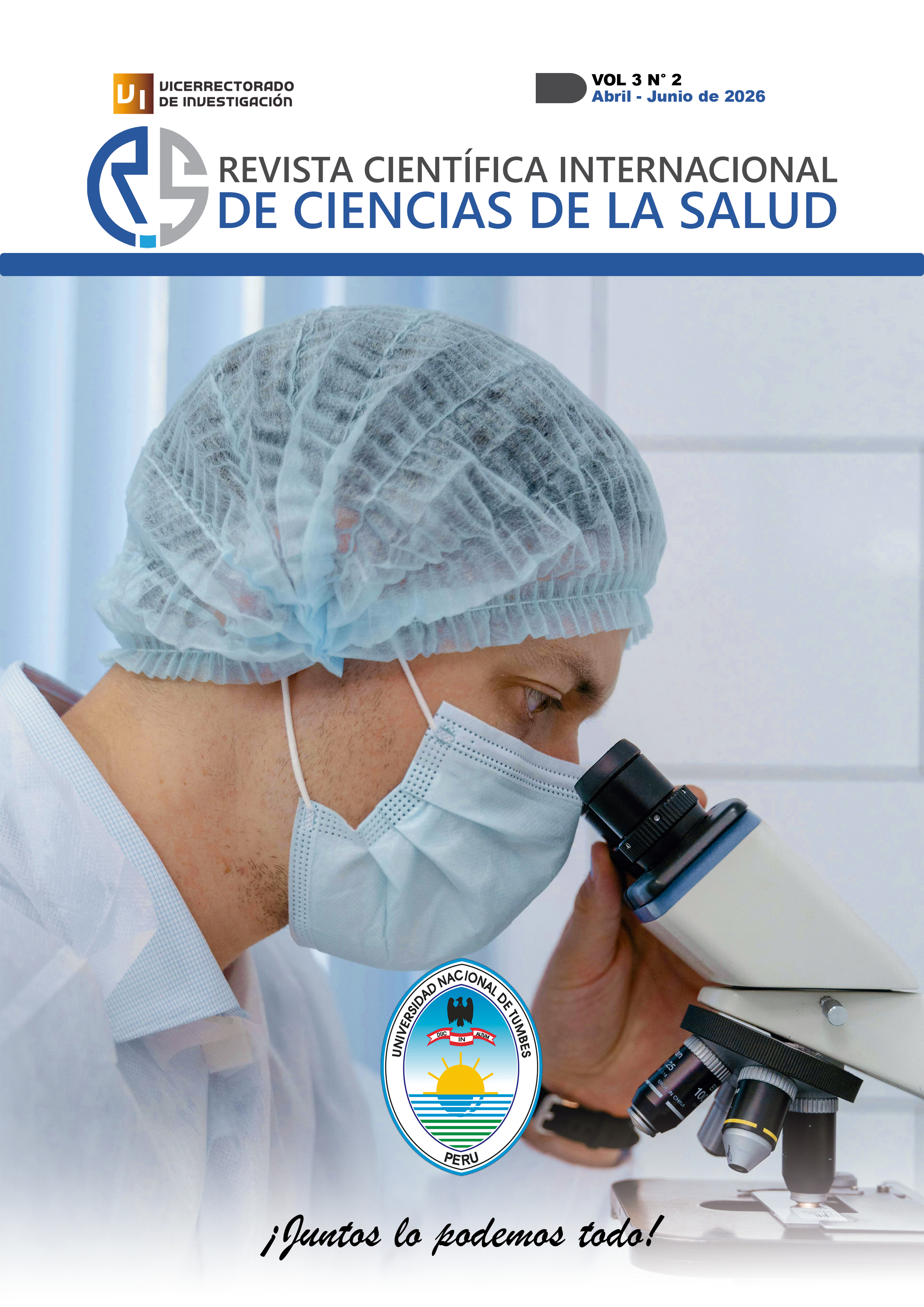
Rol de la bomba Na⁺/K⁺ ATPasa en la regulación iónica y el equilibrio homeostático celular
Role of the Na⁺/K⁺ ATPase Pump in Ionic Regulation and Cellular Homeostasis
DOI:
https://doi.org/10.57188/Palabras clave:
Na+/K+-ATPasa; Homeostasis; Transporte activo; Canales io nicos; Fisiologí a celular (Fuente: DeCS-BIREME)Resumen
La Na⁺/K⁺-ATPasa es una proteína transmembranal esencial para el mantenimiento de la homeostasis celular mediante la regulación de los gradientes electroquímicos de sodio y potasio. El objetivo de esta revisión fue analizar la evidencia científica reciente sobre el papel de la bomba Na⁺/K⁺-ATPasa en la regulación iónica y el equilibrio homeostático celular, considerando su estructura molecular, mecanismo de transporte activo, regulación fisiológica y participación en procesos fisiopatológicos. Se realizó una revisión narrativa de la literatura utilizando publicaciones científicas recientes relacionadas con fisiología celular, biología molecular y enfermedades asociadas a la disfunción de esta bomba iónica. La evidencia demuestra que la Na⁺/K⁺-ATPasa no solo mantiene el potencial de membrana, el volumen celular y el transporte activo secundario, sino que también participa en mecanismos de señalización intracelular, regulación metabólica y adaptación a diferentes demandas tisulares. Asimismo, su actividad depende de la interacción entre las subunidades α, β y las proteínas reguladoras FXYD, las cuales modulan sus propiedades funcionales según el tipo celular. Alteraciones en su funcionamiento secundarias a hipoxia, acidosis o déficit energético favorecen el desequilibrio hidroelectrolítico, edema celular y disfunción de órganos como cerebro, corazón y riñón. En conjunto, la Na⁺/K⁺-ATPasa constituye un componente central de la fisiología celular y un potencial blanco terapéutico para enfermedades cardiovasculares, neurológicas y renales asociadas con alteraciones del equilibrio iónico.
Descargas
Referencias
1. Huang S, Dong W, Lin X, Bian J. Na+/K+-ATPase: ion pump, signal transducer, or cytoprotective protein, and novel biological functions. Neural Regen Res. enero de 2024;19(12):2684-97. doi: 0.4103/NRR.NRR-D-23-01175
2. Contreras RG, Torres-Carrillo A, Flores-Maldonado C, Shoshani L, Ponce A. Na+/K+-ATPase: More than an Electrogenic Pump. Int J Mol Sci. junio de 2024;25(11):6122. doi: 10.3390/ijms25116122
3. Cordeiro BM, Leite Fontes CF, Meyer-Fernandes JR. Molecular Basis of Na, K–ATPase Regulation of Diseases: Hormone and FXYD2 Interactions. Int J Mol Sci. enero de 2024;25(24):13398. doi: 10.3390/ijms252413398
4. Kryvenko V, Wessendorf M, Morty RE, Herold S, Seeger W, Vagin O, et al. Hypercapnia Impairs Na,K-ATPase Function by Inducing Endoplasmic Reticulum Retention of the β-Subunit of the Enzyme in Alveolar Epithelial Cells. Int J Mol Sci. enero de 2020;21(4):1467. doi: 10.3390/ijms21041467
5. Mukherji ST, Brambilla L, Stuart KB, Mayes I, Kutz LC, Chen Y, et al. Na/K-ATPase Signaling Tonically Inhibits Sodium Reabsorption in the Renal Proximal Tubule. FASEB J Off Publ Fed Am Soc Exp Biol. abril de 2023;37(4):e22835. doi: 10.1096/fj.202200785RR
6. Zhang X, Lee W, Bian JS. Recent Advances in the Study of Na+/K+-ATPase in Neurodegenerative Diseases. Cells. diciembre de 2022;11(24):4075. doi: 10.3390/cells11244075
7. Gao Y, Xu Y, Bai F, Puri R, Tian J, Liu J. Factors that influence the Na/K-ATPase signaling and function. Front Pharmacol. julio de 2025;16:1639859. doi: 10.3389/fphar.2025.1639859
8. Guo Y, Zhang Y, Yan R, Huang B, Ye F, Wu L, et al. Cryo-EM structures of recombinant human sodium-potassium pump determined in three different states. Nat Commun. julio de 2022;13(1):3957. doi: 10.1038/s41467-022-31602-y
9. Nguyen PT, Deisl C, Fine M, Tippetts TS, Uchikawa E, Bai X chen, et al. Structural basis for gating mechanism of the human sodium-potassium pump. Nat Commun. septiembre de 2022;13(1):5293. doi: 10.1038/s41467-022-32990-x
10. Abe K, McDermott J, Valia Madapally H, Marimuthu P, Gopalasingam CC, Gerle C, et al. Molecular Structure of the Na+,K+-ATPase α4β1 Isoform in Its Ouabain-Bound Conformation. Int J Mol Sci. enero de 2024;25(22):12397. doi: 10.3390/ijms252212397
11. Michaels AM, Zoccarato A, Hoare Z, Firth G, Chung YJ, Kuchel PW, et al. Disrupting Na+ ion homeostasis and Na+/K+ ATPase activity in breast cancer cells directly modulates glycolysis in vitro and in vivo. Cancer Metab. mayo de 2024;12:15. doi: 10.1186/s40170-024-00343-5
12. Bejček J, Spiwok V, Kmoníčková E, Rimpelová S. Na+/K+-ATPase Revisited: On Its Mechanism of Action, Role in Cancer, and Activity Modulation. Molecules. 28 de marzo de 2021;26(7):1905. doi: 10.3390/molecules26071905
13. Peluffo RD, Hernández JA. The Na+,K+-ATPase and its stoichiometric ratio: some thermodynamic speculations. Biophys Rev. julio de 2023;15(4):539-52. doi: 10.1007/s12551-023-01082-5
14. Obradovic M, Sudar-Milovanovic E, Gluvic Z, Banjac K, Rizzo M, Isenovic ER. The Na+/K+-ATPase: A potential therapeutic target in cardiometabolic diseases. Front Endocrinol. febrero de 2023;14:1150171. doi: 10.3389/fendo.2023.1150171
15. Romero V, Gelde L, Benavente J. Electrochemical Characterization of Charged Membranes from Different Materials and Structures via Membrane Potential Analysis. Membranes. agosto de 2023;13(8):739. doi: 10.3390/membranes13080739
16. Roy D, Michalet X, Miller EW, Bharadwaj K, Weiss S. Towards measurements of absolute membrane potential in Bacillus subtilis using fluorescence lifetime. bioRxiv. diciembre de 2024;2024.06.13.598880. doi: 10.1101/2024.06.13.598880
17. Benyamin MS, Perisin MP, Hellman CA, Schwalm ND, Jahnke JP, Sund CJ. Modeling control and transduction of electrochemical gradients in acid-stressed bacteria. iScience. junio de 2023;26(7):107140. doi: 10.1016/j.isci.2023.107140
18. Gozhenko A, Zukow W, Gozhenko O, Saensus M, Vitiukov O. Pathophysiological mechanisms of integrated regulation of water-sodium homeostasis: from cellular dysfunction of Na-K-ATPase to dysregulation of systemic volume control: a systematic review. J Educ Health Sport. agosto de 2025;84:64716. doi: 10.12775/JEHS.2025.84.64716
19. Giffard-Mena I, Ponce-Rivas E, Sigala-Andrade HM, Uranga-Solís C, Re AD, Díaz F, et al. Evaluation of the osmoregulatory capacity and three stress biomarkers in white shrimp Penaeus vannamei exposed to different temperature and salinity conditions: Na+/K+ ATPase, Heat Shock Proteins (HSP), and Crustacean Hyperglycemic Hormones (CHHs). Comp Biochem Physiol B Biochem Mol Biol. abril de 2024;271:110942. doi: 10.1016/j.cbpb.2024.110942
20. Wen XP, Wan QQ. Regulatory effect of insulin on the structure, function and metabolism of Na+/K+‑ATPase (Review). Exp Ther Med. noviembre de 2021;22(5):1-8. doi: 10.3892/etm.2021.10678
21. Arystarkhova E, Sweadner KJ. Na,K-ATPase Expression Can Be Limited Post-Transcriptionally: A Test of the Role of the Beta Subunit, and a Review of Evidence. Int J Mol Sci. julio de 2024;25(13):7414. doi: 10.3390/ijms25137414
22. Farhat E, Devereaux MEM, Cheng H, Weber JM, Pamenter ME. Na+/K+-ATPase activity is regionally regulated by acute hypoxia in naked mole-rat brain. Neurosci Lett. noviembre de 2021;764:136244. doi: 10.1016/j.neulet.2021.136244
23. Hladky SB, Barrand MA. Alterations in brain fluid physiology during the early stages of development of ischaemic oedema. Fluids Barriers CNS. 10 de junio de 2024;21(1):51. doi: 10.1186/s12987-024-00534-8
24. Liu R, Collier JM, Abdul-Rahman NH, Capuk O, Zhang Z, Begum G. Dysregulation of Ion Channels and Transporters and Blood-Brain Barrier Dysfunction in Alzheimer’s Disease and Vascular Dementia. Aging Dis. agosto de 2024;15(4):1748-70. doi: 10.14336/AD.2023.1201
Publicado
Número
Sección
Licencia
Derechos de autor 2026 Mesias Mendieta Valeria Rubi, Miranda Rojas José Daniel, Montoya Abanto Julio César

Esta obra está bajo una licencia internacional Creative Commons Atribución 4.0.
RICSA is an open access journal distributed under the terms and conditions of Creative Commons Attribution 4.0 International license